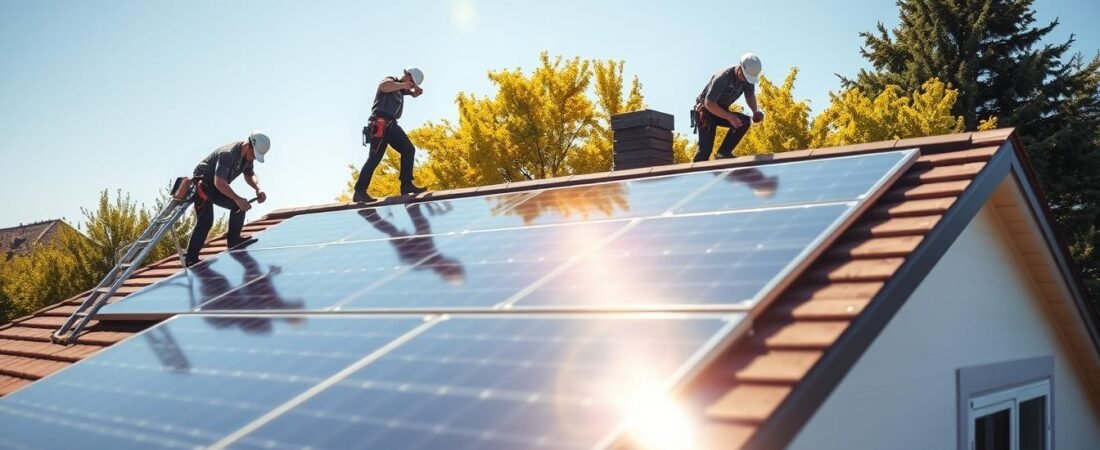
This guide explains what a rooftop project means for a typical US home. It covers planning, permitting, roof work, electrical tie‑ins, and final testing so you know what to expect.
Who is this for? Homeowners weighing DIY versus pro help will get a clear, practical path from site assessment to commissioning and monitoring.
In the past decade, installations have surged — the industry reports a new unit every 39 seconds in 2026. Most grid‑tied systems are designed to supplement utility power, not fully replace it.
Key choices include whether to offset bills, add backup for outages, or seek partial independence with batteries. Net metering can credit excess generation, but rules vary by state and utility.
Safety note: work on a roof and electrical mains carries real risk. Use a licensed electrician for main‑service tie‑ins and follow local inspections.
Remember the balance of system: inverter, wiring, mounts, and optional storage all shape overall performance. Read on for step‑by‑step detail and smart decision points.
Is Solar Right for Your Home in the United States?
More U.S. homeowners are treating home energy upgrades as routine maintenance and cost management. Adoption is now mainstream: SEIA reports a new solar panel installation every 39 seconds in 2026, which shows clear momentum for rooftop upgrades.
How adoption is accelerating
The pace reflects falling equipment costs, better incentives, and wider installer networks. Local utility rates and time-of-use pricing affect whether an array makes financial sense. Check local rebates and billing rules before you decide.
What solar can realistically cover
Most grid-tied systems without batteries are sized to supplement utility grid power and cut bills, not to erase them entirely. Net metering can credit exports, but savings depend on your rates and use patterns.
Grid-tied, off-grid, and hybrid systems at a glance
- Grid-tied: simplest and least expensive; stops during blackouts due to anti-islanding.
- Off-grid: for total independence; higher costs and complexity.
- Hybrid: adds batteries for backup and resilience; costs more but keeps essential circuits running.
| Type | Best for | Costs | Grid Outage Behavior |
|---|---|---|---|
| Grid-tied | Lowest cost, bill reduction | Low | Shuts down (anti-islanding) |
| Hybrid | Bill reduction + backup | Medium–High | Can supply critical loads |
| Off-grid | Remote or fully independent homes | High | Operates independent of grid |
Next step: evaluate roof condition, shading, household electricity use, and backup goals before committing to equipment or a contract.
Solar Panel System Basics: Components You’ll Be Installing
What goes on a typical home array starts with the modules and extends to the balance of system (BOS). BOS includes inverters, controllers, batteries, switches, and wiring that make panels useful for household electricity and backup.
Photovoltaic modules and common residential types
Most U.S. homes use rigid framed modules made from monocrystalline or polycrystalline silicon. Monocrystalline is denser and more efficient per roof foot. Polycrystalline costs less but needs more area.
Inverters and DC-to-AC conversion
An inverter converts DC from the modules into the AC your appliances use. Options include string inverters or microinverters; each has trade-offs in cost and shading tolerance.
Charge controllers, batteries, and backup
Off-grid or hybrid setups route DC through a charge controller first. MPPT controllers outperform PWM in most home systems.
Battery storage keeps critical loads on during outages and shifts energy use to evening hours.
Transfer switches, wiring, and safety
Transfer switches or smart panels safely tie backup into your main breaker box. Use UV-rated wire, MC4-compatible connectors, neat labeling, and clear cable runs for safe maintenance.
| Component | Primary Role | Key Notes |
|---|---|---|
| Modules (modules) | Generate DC | Monocrystalline = higher efficiency; polycrystalline = lower cost |
| Inverter | DC → AC | String vs microinverters affect shading and performance |
| Charge controller / Battery | Manage and store DC | MPPT preferred; batteries provide outage backup and load shifting |
Planning Your Rooftop Solar Panel Installation
A good system begins with real numbers: your monthly kWh, peak loads, and planned future devices. Gather recent utility bills and list the appliances you want to run now and later, such as an EV charger or heat pump.
Estimating usage and sizing
Translate monthly kWh into array watts and inverter size. Count starting (surge) and running watts for major loads; surges can drive inverter choice when you want backup. Add 10–20% for future needs.
Roof condition and leak prevention
Check shingle age and rafters for strength. Fix damage and replace worn areas before mounts go in. Proper flashing and sealed penetrations prevent leaks and costly rework.
Sun exposure and layout
Map shade from trees, chimneys, and vents. Better placement often boosts efficiency more than adding panels. Aim for unobstructed southern or solar‑friendly areas when possible.
Permits, HOA, and utility steps
Expect AHJ permits, HOA sign‑off, and utility interconnection reviews that may need site plans, wiring diagrams, and spec sheets. Timeline can take weeks, so start paperwork early.
Buying, financing, or DIY choices
Cash buy gives max savings and credits. Loans spread costs; leases shift ownership and incentives. Many homeowners do racking as a diy project but hire a licensed electrician for service‑panel work to stay safe and code‑compliant.
Document everything: one‑line diagrams, cut sheets, and photos of rafter attachments make inspections and future service smoother.
Tools, Materials, and Safety Gear for Installing Solar Panels
A clean tool bench and the right gear make a big difference before you climb onto a roof. Gather power tools, testing meters, and all mounting hardware before any work starts.
Must-have tools and electrical testers
Bring a cordless drill/impact driver, socket set, level, tape measure, chalk line, and wire strippers. A quality multimeter and MC4 crimp tool let you verify voltage and polarity to avoid equipment damage.
Mounting materials and weatherproofing
Use rails, clamps, roof mounts with flashing, and a weatherproof sealant. Cutting corners on flashing leads to leaks and long-term roof damage.
Wiring, connectors, and code notes
Stock MC4 connectors, UV-rated cable, conduit, combiner box, labels, and proper fasteners. Local code varies, so confirm conduit runs and grounding before final wiring.
Safety essentials and handling
Safety first: harness and anchor points, stable ladder or scaffold, hard hat, gloves, safety glasses, boots, and a fire extinguisher. Panels are awkward; plan for at least two people or a lifting device to avoid dropping a solar panel.
| Category | Example Items | Why it matters |
|---|---|---|
| Tools | Drill, level, multimeter | Accurate mounts and safe electrical checks |
| Mounting Hardware | Rails, clamps, flashing, sealant | Long-term watertight mounting system |
| Safety Gear | Harness, ladder, PPE, extinguisher | Prevents falls, injury, and fire risk |
Mounting the Racking System on Your Roof
Start the racking step by finding the structure under the roof sheathing where fasteners will carry loads. Fastening into rafters prevents pull‑out from wind or snow loads and keeps the array secure over time.
Locating rafters and marking rail placement
Check attic measurements, use a stud finder, or consult construction plans to locate rafters reliably. Mark each location and snap chalk lines so rail runs stay square to the eaves and match your layout for conduit and cable paths.
Installing mounts and flashing for a watertight seal
Lift shingles carefully to slide in flashing under the weather course. Bolt flashing to the rafter, use the correct fastener length, and seal with a compatible roof sealant to prevent leaks and hidden damage.
Aligning rails and quality checks
Use a level or laser to make rails straight, parallel, and evenly spaced so panels clamp cleanly and don’t twist over time. Re‑check torque, confirm each mount hits a rafter, and inspect every penetration before moving on.
Note: asphalt shingle roofs are most common; tile or metal roofs need specialized mounting hardware and methods. Accurate racking improves efficiency, reduces stress on panels, and helps pass inspection.
Installing and Wiring Solar Panels on the Roof
Careful handling and neat wiring on the roof cut the risk of damage and speed final inspection.
Lifting and securing without damage
Stage panels near their mounting rows and use two‑person carries or a lift. Set each unit on rails—do not drag frames across clamps. Tighten clamps to the manufacturer’s torque and recheck after the first row.
Series vs parallel: volts, amps, and a quick example
Series wiring increases voltage; amperage stays the same. Parallel wiring raises amperage; voltage stays constant. Watts = volts × amps.
| Config | Volts | Amps | Total Watts |
|---|---|---|---|
| 3×400W in series | 93V | 12.9A | 1,200W |
| 3×400W in parallel | 31V | 38.7A | 1,200W |
Hybrid strings, combiner boxes, and cable runs
Hybrid series/parallel layouts balance string voltage and current for large arrays and shade tolerance. Use a combiner box to consolidate strings before the inverter and run conduit for protection and code compliance.
Caution: miswiring can overload equipment and void warranties. Label every string, secure cables with drip loops, and avoid sharp bends for long life and easier troubleshooting.
Connecting the Balance of System: Inverter, Battery, and Home Integration
The balance-of-system hookup defines how power flows from generation and storage into lived-in spaces. Start by mapping the sequence: modules → charge controller (if hybrid) → battery bank → inverter → main service or transfer switch for selected circuits.
Where to mount the inverter
Mount the inverter in an accessible, dry spot with good airflow and no direct sun. Keep it near the battery bank when possible to shorten DC runs and reduce losses.
Practical checks: reachable for service, weather protected, and within the manufacturer’s clearance recommendations.
Battery setup basics
Place batteries on a stable, level surface away from living areas if ventilation is needed. Lead‑acid types need periodic checks; LFP/LiFePO4 typically requires little maintenance and offers wider siting options.
Temperature matters: avoid extreme heat or freezing to extend service life and keep safety risks low.
Transfer switches and panel tie-ins
Use a transfer switch or smart panel to isolate backup loads and prevent backfeed to the grid. Main service tie‑ins involve high voltages and arc risk—hire a licensed electrician for final connections and inspections.
Grid connection, net metering, and monitoring
Most utilities use a bidirectional meter to credit exports. Grid‑tied systems without storage automatically shut off during outages for safety. Set up monitoring apps and portals early so you can confirm production and spot wiring faults in the first week.
| Component | Key Placement | Notes |
|---|---|---|
| Inverter | Accessible, dry, ventilated | Short DC runs; service access |
| Battery | Stable surface, ventilated if lead-acid | LFP requires less maintenance than lead-acid |
| Transfer switch / Smart panel | Near main service panel | Separates critical loads; prevents backfeed |
| Monitoring | Configured at commissioning | Catch issues fast; track production and export |
For a practical how-to on tying generation into household electricity, see this guide: connect panels to home electricity. To learn about professional support and services, visit about our team.
Conclusion
, After hardware is in place, the last steps focus on inspection, interconnection, and routine care. Recap the journey: evaluate fit, plan and permit, mount racking, set panels, wire correctly, integrate inverter and battery, then inspect and commission.
Safety matters as much as equipment. Keep roof penetrations sealed, follow code, and hire a licensed electrician for main‑service work. Use a “measure twice, install once” approach to avoid rework and weak connections.
DIY makes sense for mechanical racking or basic array work for experienced homeowners. Always hire a pro for final electrical tie‑ins, transfer switches, and AHJ interactions.
After install, pass inspection, secure PTO from the utility, enable monitoring, and track output. Do simple maintenance: clear debris, check cables and sealant, and watch inverter app alerts.
Enjoy lower electricity dependence, better energy visibility, and the option to add storage for resilience when outages occur.