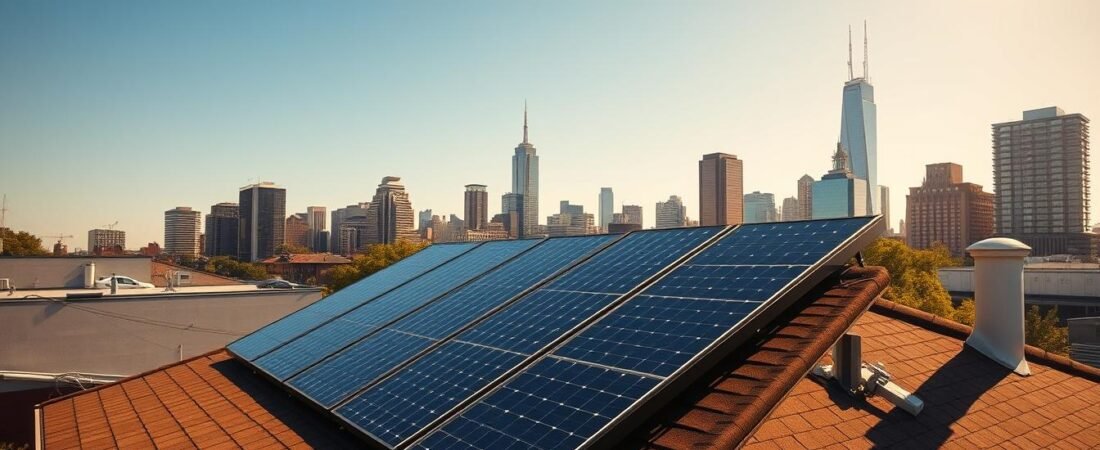
Quick answer: In 2026 expect installed pricing near $2.90–$3.25 per watt, so a typical 6 kW system runs about $19,000 installed. This guide shows total installed price per watt versus equipment-only pricing and why the full installation figure matters when you compare offers.
Important: the 30% federal tax credit has expired for homeowners. All homeowner-owned examples in this guide assume $0 federal residential tax credit, so readers do not overestimate incentives.
This Buyer’s Guide is for single-family and brownstone owners, multi-family decision-makers, and condo residents weighing rooftop or community options. It previews per-watt ranges, typical system totals, and how local incentives, SREC-II value, and net metering alter real payback.
We explain what changes your price—roof access, permitting, and electrical upgrades—and use a simple decision framework: upfront cost, annual bill savings, yearly incentive income, and payback period. Use the rest of the article to pressure-test proposals and avoid apples-to-oranges comparisons on equipment, warranties, or assumptions.
What Jersey City Homeowners Pay for Solar in 2026
Comparing offers starts with a simple number: the installed price per watt today. The current local band runs about $2.90–$3.25 per watt, which is the cleanest way to compare quotes across installers and equipment packages.
Typical installed price range
Use per watt to normalize different equipment and inverter choices. That number shows true prices and helps you spot lowball versus full-service bids.
Example: a 6 kW system
Math check: 6,000 watts × $2.90–$3.25/W = ~$17,400–$19,500 installed. This gives a quick sanity check when you review proposals.
Real-world payoff snapshot
The ~7.8-year payback estimate reflects electricity bill offsets plus SREC‑II income and full retail net metering in PSE&G territory. This is a cash-purchase style calculation.
- Fully installed means panels, inverter(s), racking, wiring, labor, permitting, and interconnection support.
- Two bids can differ due to roof access, electrical upgrades, equipment tier, and warranty terms.
- System size should be driven by your kWh usage and roof constraints—not national averages.
Next: a size-by-size cost table and how local incentives layer into total savings and payback period.
Solar Panel Cost Jersey City by System Size
Choose a system size that matches your household needs and roof limits—this section maps typical price bands to real-life use cases.
Small roofs and condos (4 kW)
4 kW systems suit tight roofs and many condo setups where shared roof rights limit placement. Expect about $11,600–$13,000 installed and roughly $410 per year in SREC‑II income.
Average Jersey City home (6 kW)
A 6 kW system is the local baseline: $17,400–$19,500 installed. Production is about 7,800 kWh/year, which directly ties installed spend to bill savings and incentive income of ~$620/year.
Brownstones and multi-family (8 kW)
For brownstones or buildings with common loads, an 8 kW option offers more shared value. Typical pricing runs $23,200–$26,000 with SREC‑II near $825/year.
High-usage households (10 kW)
Large homes with EV charging or electric heat may need ~10 kW. Budget $29,000–$32,500, and expect about $1,030/year from SREC‑II. Check roof area and electrical panel capacity before sizing up.
| System Size | Installed Price Range | Estimated SREC‑II / year | Typical Use Case |
|---|---|---|---|
| 4 kW | $11,600–$13,000 | $410 | Small roofs, condos, shared roofs |
| 6 kW | $17,400–$19,500 | $620 | Average home — ~7,800 kWh/yr production |
| 8 kW | $23,200–$26,000 | $825 | Brownstones, multi-family common loads |
| 10 kW | $29,000–$32,500 | $1,030 | High usage: EVs, heat pumps, large households |
Buyer guidance: inverter type, module tier, and roof geometry change real output and long-term value. Ask installers for modeled production and a years-based SREC‑II payout schedule so you can challenge overly optimistic estimates or unusually low bids that skip needed equipment or upgrades.
Why Solar Costs More in Jersey City Than Other Parts of New Jersey
Dense urban rooftops and tight street access make installations in Hudson County more complex than suburban jobs.
Density-driven install complexity
In tightly built neighborhoods, staging space is scarce. That means longer carry distances, more lifts, and extra crew time.
Limited parking and narrow streets force crews to schedule special loading plans. Those logistics raise labor and scheduling overhead.
Labor, permitting, and local rules
Hudson County labor rates run higher than many other New Jersey areas. Skilled crews charge more for tough rooftop work.
Permitting and inspections here add admin time. Extended timelines create soft costs that installers pass to homeowners.
Roof and electrical variables that move price
- Height & access: taller buildings or walk-up carry add hours and safety gear.
- Roof condition: older or patched roofs need repairs before work begins.
- Shading & setbacks: adjacent buildings can cut production and require different layout.
- Electrical upgrades: panel swaps, service upgrades, and long conduit runs raise scope and safety.
| Driver | How it Raises Price | What to Confirm in the Quote |
|---|---|---|
| Limited staging | Extra crew time, lifts, traffic controls | Includes rigging and lift permits |
| Permit/inspection delays | Soft costs, longer schedule | Shows permit fees and timeline allowance |
| Electrical work | Additional labor and parts | Details panel/service scope and costs |
Quick takeaway: If two quotes differ by 20% or more, ask whether site-specific factors explain the gap. The lowest price is not always the best value in dense urban settings.
Incentives and Credits That Reduce Solar Costs in Jersey City
Understanding how credits and exemptions stack will help you compare true out‑of‑pocket prices and payback. Even without a homeowner federal tax credit in 2026, local and state programs still deliver meaningful savings.
New Jersey sales tax exemption
What it does: equipment and installation are exempt from the 6.625% state sales tax. For a typical ~$19,000 installed system, that avoidance equals about $1,259 in immediate savings.
Property tax exemption
Why it matters: added home value from an installed system is excluded from property tax increases. In a high‑tax market where typical property bills run around $11,000/year, this protects homeowners from higher annual taxes.
How incentives and credits stack
Think of incentives in two buckets: tax-related exemptions (sales and property) and utility bill credits (net metering + SREC‑II). They work together to boost returns and reduce payback time.
- Buyer ROI framework: start with installed price minus immediate exemptions.
- Add annual benefits: electricity bill savings + SREC‑II income.
- Confirm compliance: proper permitting, interconnection, and registration are required to receive these benefits.
Quick takeaway: evaluate offers on net installed cost and persistent annual income, not sticker price alone. SREC‑II and PSE&G net metering remain the two biggest ongoing value drivers for most systems in this market.
SREC-II in Jersey City: How Much It Pays and How Long It Lasts
SREC‑II is a performance-based incentive that pays you for actual energy production, measured per MWh, for a fixed term. It is not a one-time rebate; payments arrive as your system produces power. That makes SREC‑II a predictable income stream you can model into cash-flow and loan calculations.
How the program works and its duration
SREC‑II pays for every MWh your array generates for 15 years. That 15‑year window gives homeowners medium-term certainty and a steady layer of income on top of bill savings.
Example: a typical 6 kW system
Assume ~7.8 MWh/year production for a 6 kW system. At current SREC‑II rates, that converts to about $620 per year in incentive payments.
Over the 15‑year term, that equals roughly $9,300 in total SREC‑II receipts for an average 6 kW installation. This amount meaningfully improves payback and monthly cash flow.
- What moves payments: shading, orientation, panel uptime, and inverter choices affect yearly output and earnings.
- Practical use: many owners apply SREC‑II income to loan payments to lower net monthly outflow.
- Buyer checklist: confirm your installer handles registration, meter reporting, and eligibility so you actually receive credits for years to come.
Next value lever: pair SREC‑II income with full retail net metering to maximize long-term savings and overall value.
PSE&G Net Metering: Bill Credits, Retail Rates, and Annual Savings
How your system interacts with PSE&G meters has a big impact on annual energy savings.
How full retail metering works
PSE&G credits exported power at the full retail electricity rate. Credits roll over month to month and then true up once a year. That means excess generation becomes a dollar offset against your energy charges.
Rate context and a practical example
Use ~$0.26/kWh as a working rates benchmark to translate kWh into dollars. For an average system that nets about 7,800 kWh/year, that converts to roughly $2,030 per year in utility bill savings.
What net metering actually offsets
Net metering typically reduces the energy portion of your bill. Expect fixed service fees, delivery charges, and some regulatory line items to remain on many statements.
Quick tip: check your latest PSE&G bill to confirm the effective retail rate your account shows. If an installer assumes a higher rate or aggressive escalation, ask for a sensitivity check—overstated rates inflate projected savings and shorten payback artificially.
| Feature | How it Works | Example Value |
|---|---|---|
| Credit type | Full retail bill credits for exported power | ~$0.26/kWh |
| Billing cadence | Monthly rollover + annual true-up | Credits carry month-to-month |
| Estimated annual savings | Production × retail rate | ~$2,030/year (example) |
Why this matters: net metering is often the single largest recurring value driver year-to-year, especially when paired with SREC‑II income. That value stands even in 2026 without a homeowner federal tax credit.
Federal Tax Credit Update for 2026: What Changed and What Still Applies
The 2026 policy shift removes a major federal purchase incentive for owner-occupied installations.
What changed: Residential Section 25D (the 30% homeowner credit) expired after December 31, 2025. That means homeowners who buy a system with cash or a loan receive $0 federal credit in 2026.
What this means for budgeting
Without that federal tax credit, net price is driven by state exemptions, SREC‑II income, and full retail net metering. Expect those items to shape payback and monthly math more than a one-time federal rebate.
Third‑party ownership exception
Commercial Section 48 ITC still applies to third-party owners. PPA and lease providers can claim that credit and sometimes reflect it in lower upfront offers.
- Watch for proposals that imply homeowners still “get 30% back” in 2026—ask for plain math.
- If you want long-term gains and SREC‑II income, compare cash vs loan ownership calculations.
- If you prefer low upfront payments, request clear PPA or lease pricing and note the third‑party credit role.
Learn how no homeowner federal tax credit affects payments as you weigh financing choices; payment method now matters even more for final value.
How to Pay for Solar in Jersey City: Cash, Loan, PPA, and Lease Options
Your financing choice determines who owns the system, who gets incentives, and how fast you break even.
Cash purchase
Why it works: paying cash (~$19,000 typical) gives the strongest long-term savings and about a 7.8-year payback for a common 6 kW setup.
Pros: you keep SREC-II income and avoid interest. Best solar for owners focused on total returns.
Loan
Loans offer ownership with $0 down and monthly payments in the ~$145–190 range. SREC‑II checks can offset payments.
Choose fixed terms and confirm net monthly impact versus your current bill.
PPA (Power Purchase Agreement)
With a PPA, a third party owns the array and you buy electricity at a set rate (~$0.14–0.18/kWh).
Good for buyers wanting no upfront price and low maintenance responsibility.
Lease
Leases are fixed monthly payments (~$75–110) and are common for condos and multi-family buildings. You trade ownership upside for simplicity.
- Buyer checklist: escalator rates, contract length, warranty duty, transfer on sale, and who registers SREC‑II.
- Request a cash price and an ownership-financed price for true apples-to-apples comparisons.
Which is best? Cash for max savings, loan for ownership with low upfront outlay, PPA/lease for minimal hassle. Pick the path that matches your budget and goals.
Community Solar in Jersey City: The Best Solar Option Without a Suitable Roof
For renters and condo owners, subscribing to a shared project is a practical way to get clean solar energy without on-site work.
How subscriptions work
You join a local farm and receive PSE&G bill credits tied to your account. Those credits appear on your monthly electricity statement from the utility, reducing what you owe.
Typical benefits
Most subscribers see about 10%–20% savings with $0 upfront and simple cancellation terms. Results vary by project size and contract details.
When rooftop ownership still wins
If your home has usable roof space and you can own the system, rooftop installations often deliver larger long‑term returns and SREC‑II income compared with a subscription.
- Why choose community: no construction, no maintenance, flexible term.
- How it appears on bills: utility credits offset energy charges, not fixed delivery fees.
- Quick checklist: roof suitability, ownership preference, length of stay, contract flexibility.
Explore local community options and program details at community solar programs to see which path offers the best solar value for your situation.
Conclusion
A clear benchmark helps you spot low bids and protect long-term returns when comparing local offers.
Use the $2.90–$3.25 per watt range and the 6 kW example (~$17,400–$19,500) as sanity checks. A fully installed system should include modules, inverter, racking, wiring, labor, permits, and interconnection support.
Remember: typical cash payback sits near 7.8 years using PSE&G full retail credits (~$0.26/kWh) plus SREC‑II (~$620/yr for ~15 years, ~ $9,300 total). New Jersey sales tax and property tax exemptions materially improve net savings.
Section 25D expired for homeowners in 2026; third‑party owners may still use Section 48. Match size to usage and roof limits, verify production assumptions, and pick financing that fits your timeline.
Next step: request a local estimate that factors roof access, electrical upgrades, and your actual PSE&G rate so you can compare true price and long‑term value.
FAQ
How much do solar panels cost in Jersey City?
What do Jersey City homeowners pay for a 6 kW system in 2026?
How do prices vary by system size for different home types?
Why are installations in Jersey City often pricier than elsewhere in New Jersey?
What local incentives help lower the installed price?
What is SREC-II and how much can I earn in Jersey City?
How does PSE&G net metering work and what savings should I expect?
FAQ
How much do solar panels cost in Jersey City?
Typical installed prices in Jersey City in 2026 run about .90–.25 per watt. That means a 6 kW system usually lands between ,400 and ,500 fully installed before any incentives or tax credits. Local labor, roof complexity, and equipment choice all influence the final price.
What do Jersey City homeowners pay for a 6 kW system in 2026?
For an average home, a 6 kW system typically costs around ,400–,500 installed. With current incentives and PSE&G net metering, many homeowners see a local payback near 7.8 years, depending on electricity use and financing.
How do prices vary by system size for different home types?
Small roofs and condos often use ~4 kW systems, which cost less up front and may still qualify for SREC-II payments. Average single-family homes commonly install 6 kW systems. Brownstones or multi-family buildings might need ~8 kW, while high-usage households may go to 10 kW or more. Per-watt price typically drops slightly as system size increases, but roof complexity can raise labor costs.
Why are installations in Jersey City often pricier than elsewhere in New Jersey?
Dense urban conditions increase complexity: tight roof access, staging limits, and logistics add time and labor. Hudson County permitting and inspection rules can extend timelines. Roof height, condition, shading, and required electrical upgrades also push up prices compared with suburban installs.
What local incentives help lower the installed price?
Jersey City homeowners benefit from New Jersey’s sales tax exemption on equipment and a property tax exemption that prevents your assessed value from increasing because of the system. Those savings, combined with net metering credits and SREC-II payments, significantly improve return on investment.
What is SREC-II and how much can I earn in Jersey City?
SREC-II is a performance-based incentive that pays for each megawatt-hour produced over a defined period. A 6 kW system producing roughly 7.8 MWh/year might earn about 0 annually today, and over 15 years that can add up to roughly ,300, subject to market changes and program rules.
How does PSE&G net metering work and what savings should I expect?
Full retail net metering provides monthly rollovers and an annual true-up for excess generation. In PSE&G territory, credits often tie to roughly
FAQ
How much do solar panels cost in Jersey City?
Typical installed prices in Jersey City in 2026 run about $2.90–$3.25 per watt. That means a 6 kW system usually lands between $17,400 and $19,500 fully installed before any incentives or tax credits. Local labor, roof complexity, and equipment choice all influence the final price.
What do Jersey City homeowners pay for a 6 kW system in 2026?
For an average home, a 6 kW system typically costs around $17,400–$19,500 installed. With current incentives and PSE&G net metering, many homeowners see a local payback near 7.8 years, depending on electricity use and financing.
How do prices vary by system size for different home types?
Small roofs and condos often use ~4 kW systems, which cost less up front and may still qualify for SREC-II payments. Average single-family homes commonly install 6 kW systems. Brownstones or multi-family buildings might need ~8 kW, while high-usage households may go to 10 kW or more. Per-watt price typically drops slightly as system size increases, but roof complexity can raise labor costs.
Why are installations in Jersey City often pricier than elsewhere in New Jersey?
Dense urban conditions increase complexity: tight roof access, staging limits, and logistics add time and labor. Hudson County permitting and inspection rules can extend timelines. Roof height, condition, shading, and required electrical upgrades also push up prices compared with suburban installs.
What local incentives help lower the installed price?
Jersey City homeowners benefit from New Jersey’s sales tax exemption on equipment and a property tax exemption that prevents your assessed value from increasing because of the system. Those savings, combined with net metering credits and SREC-II payments, significantly improve return on investment.
What is SREC-II and how much can I earn in Jersey City?
SREC-II is a performance-based incentive that pays for each megawatt-hour produced over a defined period. A 6 kW system producing roughly 7.8 MWh/year might earn about $620 annually today, and over 15 years that can add up to roughly $9,300, subject to market changes and program rules.
How does PSE&G net metering work and what savings should I expect?
Full retail net metering provides monthly rollovers and an annual true-up for excess generation. In PSE&G territory, credits often tie to roughly $0.26 per kWh. For an average 6 kW system, that can translate to about $2,030 per year in avoided electricity costs, varying with personal usage and system output.
Is there a federal tax credit for residential systems in 2026?
Residential Section 25D expired after December 31, 2025, so homeowners generally do not receive a federal credit for purchases in 2026. Third-party ownership (PPAs and leases) can still be deployed under Section 48, which applies to tax-paying project owners such as developers.
What payment options are available for Jersey City homeowners?
Common paths include cash purchase (best long-term savings), solar loans (ownership with possible $0 down), PPAs (buy power from a third party), and leases (fixed monthly payment). Loans and cash let you capture incentives and SREC-II income; PPAs and leases shift ownership and often suit renters or condo owners.
What if my roof isn’t suitable — is community solar a good choice?
Community solar lets you subscribe to an offsite array and receive bill credits from PSE&G. Typical savings range 10%–20% with little or no upfront cost and flexible cancellation. For many without viable roofs, it’s the best immediate option, though rooftop systems still offer larger lifetime savings when feasible.
How do installers estimate payback and system production?
Installers use your historical utility bills, roof orientation, shading analysis, and local irradiance data to model annual production. They then combine that with local retail electricity rates, net metering value, and incentive estimates (like SREC-II) to project payback and lifetime savings. Get at least three written quotes to compare assumptions and warranties.
Can SREC-II and net metering be combined with financing to improve returns?
Yes. Combining performance payments, net metering credits, and a low-rate loan often improves cash flow and shortens payback. SREC-II income can help offset monthly loan payments, making ownership accessible with limited or no down payment in many cases.
How long do systems typically last and what maintenance is required?
Modern systems commonly last 25–30 years or more. Panels require minimal maintenance—periodic cleaning and visual inspections. Inverters may need replacement sooner, often around 10–15 years. Good installers include performance guarantees and provide monitoring to detect issues early.
How does roof condition affect my project?
A sound roof saves money. If your roof needs replacement soon, many installers recommend doing that first because removing panels to reroof adds cost. Complex roofs with multiple planes or heavy shading require additional labor or equipment, which raises the installation price.
Where can I find reputable installers and compare quotes?
Look for installers with strong local references, NJ Clean Energy experience, and clear warranty terms. Check reviews on Google and Better Business Bureau, verify licenses and insurance, and request detailed proposals showing equipment specs, production estimates, permit handling, and warranty coverage. Comparing multiple bids ensures you get fair pricing and accurate projections.
FAQ
How much do solar panels cost in Jersey City?
Typical installed prices in Jersey City in 2026 run about .90–.25 per watt. That means a 6 kW system usually lands between ,400 and ,500 fully installed before any incentives or tax credits. Local labor, roof complexity, and equipment choice all influence the final price.
What do Jersey City homeowners pay for a 6 kW system in 2026?
For an average home, a 6 kW system typically costs around ,400–,500 installed. With current incentives and PSE&G net metering, many homeowners see a local payback near 7.8 years, depending on electricity use and financing.
How do prices vary by system size for different home types?
Small roofs and condos often use ~4 kW systems, which cost less up front and may still qualify for SREC-II payments. Average single-family homes commonly install 6 kW systems. Brownstones or multi-family buildings might need ~8 kW, while high-usage households may go to 10 kW or more. Per-watt price typically drops slightly as system size increases, but roof complexity can raise labor costs.
Why are installations in Jersey City often pricier than elsewhere in New Jersey?
Dense urban conditions increase complexity: tight roof access, staging limits, and logistics add time and labor. Hudson County permitting and inspection rules can extend timelines. Roof height, condition, shading, and required electrical upgrades also push up prices compared with suburban installs.
What local incentives help lower the installed price?
Jersey City homeowners benefit from New Jersey’s sales tax exemption on equipment and a property tax exemption that prevents your assessed value from increasing because of the system. Those savings, combined with net metering credits and SREC-II payments, significantly improve return on investment.
What is SREC-II and how much can I earn in Jersey City?
SREC-II is a performance-based incentive that pays for each megawatt-hour produced over a defined period. A 6 kW system producing roughly 7.8 MWh/year might earn about 0 annually today, and over 15 years that can add up to roughly ,300, subject to market changes and program rules.
How does PSE&G net metering work and what savings should I expect?
Full retail net metering provides monthly rollovers and an annual true-up for excess generation. In PSE&G territory, credits often tie to roughly
FAQ
How much do solar panels cost in Jersey City?
Typical installed prices in Jersey City in 2026 run about $2.90–$3.25 per watt. That means a 6 kW system usually lands between $17,400 and $19,500 fully installed before any incentives or tax credits. Local labor, roof complexity, and equipment choice all influence the final price.
What do Jersey City homeowners pay for a 6 kW system in 2026?
For an average home, a 6 kW system typically costs around $17,400–$19,500 installed. With current incentives and PSE&G net metering, many homeowners see a local payback near 7.8 years, depending on electricity use and financing.
How do prices vary by system size for different home types?
Small roofs and condos often use ~4 kW systems, which cost less up front and may still qualify for SREC-II payments. Average single-family homes commonly install 6 kW systems. Brownstones or multi-family buildings might need ~8 kW, while high-usage households may go to 10 kW or more. Per-watt price typically drops slightly as system size increases, but roof complexity can raise labor costs.
Why are installations in Jersey City often pricier than elsewhere in New Jersey?
Dense urban conditions increase complexity: tight roof access, staging limits, and logistics add time and labor. Hudson County permitting and inspection rules can extend timelines. Roof height, condition, shading, and required electrical upgrades also push up prices compared with suburban installs.
What local incentives help lower the installed price?
Jersey City homeowners benefit from New Jersey’s sales tax exemption on equipment and a property tax exemption that prevents your assessed value from increasing because of the system. Those savings, combined with net metering credits and SREC-II payments, significantly improve return on investment.
What is SREC-II and how much can I earn in Jersey City?
SREC-II is a performance-based incentive that pays for each megawatt-hour produced over a defined period. A 6 kW system producing roughly 7.8 MWh/year might earn about $620 annually today, and over 15 years that can add up to roughly $9,300, subject to market changes and program rules.
How does PSE&G net metering work and what savings should I expect?
Full retail net metering provides monthly rollovers and an annual true-up for excess generation. In PSE&G territory, credits often tie to roughly $0.26 per kWh. For an average 6 kW system, that can translate to about $2,030 per year in avoided electricity costs, varying with personal usage and system output.
Is there a federal tax credit for residential systems in 2026?
Residential Section 25D expired after December 31, 2025, so homeowners generally do not receive a federal credit for purchases in 2026. Third-party ownership (PPAs and leases) can still be deployed under Section 48, which applies to tax-paying project owners such as developers.
What payment options are available for Jersey City homeowners?
Common paths include cash purchase (best long-term savings), solar loans (ownership with possible $0 down), PPAs (buy power from a third party), and leases (fixed monthly payment). Loans and cash let you capture incentives and SREC-II income; PPAs and leases shift ownership and often suit renters or condo owners.
What if my roof isn’t suitable — is community solar a good choice?
Community solar lets you subscribe to an offsite array and receive bill credits from PSE&G. Typical savings range 10%–20% with little or no upfront cost and flexible cancellation. For many without viable roofs, it’s the best immediate option, though rooftop systems still offer larger lifetime savings when feasible.
How do installers estimate payback and system production?
Installers use your historical utility bills, roof orientation, shading analysis, and local irradiance data to model annual production. They then combine that with local retail electricity rates, net metering value, and incentive estimates (like SREC-II) to project payback and lifetime savings. Get at least three written quotes to compare assumptions and warranties.
Can SREC-II and net metering be combined with financing to improve returns?
Yes. Combining performance payments, net metering credits, and a low-rate loan often improves cash flow and shortens payback. SREC-II income can help offset monthly loan payments, making ownership accessible with limited or no down payment in many cases.
How long do systems typically last and what maintenance is required?
Modern systems commonly last 25–30 years or more. Panels require minimal maintenance—periodic cleaning and visual inspections. Inverters may need replacement sooner, often around 10–15 years. Good installers include performance guarantees and provide monitoring to detect issues early.
How does roof condition affect my project?
A sound roof saves money. If your roof needs replacement soon, many installers recommend doing that first because removing panels to reroof adds cost. Complex roofs with multiple planes or heavy shading require additional labor or equipment, which raises the installation price.
Where can I find reputable installers and compare quotes?
Look for installers with strong local references, NJ Clean Energy experience, and clear warranty terms. Check reviews on Google and Better Business Bureau, verify licenses and insurance, and request detailed proposals showing equipment specs, production estimates, permit handling, and warranty coverage. Comparing multiple bids ensures you get fair pricing and accurate projections.
.26 per kWh. For an average 6 kW system, that can translate to about ,030 per year in avoided electricity costs, varying with personal usage and system output.
Is there a federal tax credit for residential systems in 2026?
Residential Section 25D expired after December 31, 2025, so homeowners generally do not receive a federal credit for purchases in 2026. Third-party ownership (PPAs and leases) can still be deployed under Section 48, which applies to tax-paying project owners such as developers.
What payment options are available for Jersey City homeowners?
Common paths include cash purchase (best long-term savings), solar loans (ownership with possible
FAQ
How much do solar panels cost in Jersey City?
Typical installed prices in Jersey City in 2026 run about $2.90–$3.25 per watt. That means a 6 kW system usually lands between $17,400 and $19,500 fully installed before any incentives or tax credits. Local labor, roof complexity, and equipment choice all influence the final price.
What do Jersey City homeowners pay for a 6 kW system in 2026?
For an average home, a 6 kW system typically costs around $17,400–$19,500 installed. With current incentives and PSE&G net metering, many homeowners see a local payback near 7.8 years, depending on electricity use and financing.
How do prices vary by system size for different home types?
Small roofs and condos often use ~4 kW systems, which cost less up front and may still qualify for SREC-II payments. Average single-family homes commonly install 6 kW systems. Brownstones or multi-family buildings might need ~8 kW, while high-usage households may go to 10 kW or more. Per-watt price typically drops slightly as system size increases, but roof complexity can raise labor costs.
Why are installations in Jersey City often pricier than elsewhere in New Jersey?
Dense urban conditions increase complexity: tight roof access, staging limits, and logistics add time and labor. Hudson County permitting and inspection rules can extend timelines. Roof height, condition, shading, and required electrical upgrades also push up prices compared with suburban installs.
What local incentives help lower the installed price?
Jersey City homeowners benefit from New Jersey’s sales tax exemption on equipment and a property tax exemption that prevents your assessed value from increasing because of the system. Those savings, combined with net metering credits and SREC-II payments, significantly improve return on investment.
What is SREC-II and how much can I earn in Jersey City?
SREC-II is a performance-based incentive that pays for each megawatt-hour produced over a defined period. A 6 kW system producing roughly 7.8 MWh/year might earn about $620 annually today, and over 15 years that can add up to roughly $9,300, subject to market changes and program rules.
How does PSE&G net metering work and what savings should I expect?
Full retail net metering provides monthly rollovers and an annual true-up for excess generation. In PSE&G territory, credits often tie to roughly $0.26 per kWh. For an average 6 kW system, that can translate to about $2,030 per year in avoided electricity costs, varying with personal usage and system output.
Is there a federal tax credit for residential systems in 2026?
Residential Section 25D expired after December 31, 2025, so homeowners generally do not receive a federal credit for purchases in 2026. Third-party ownership (PPAs and leases) can still be deployed under Section 48, which applies to tax-paying project owners such as developers.
What payment options are available for Jersey City homeowners?
Common paths include cash purchase (best long-term savings), solar loans (ownership with possible $0 down), PPAs (buy power from a third party), and leases (fixed monthly payment). Loans and cash let you capture incentives and SREC-II income; PPAs and leases shift ownership and often suit renters or condo owners.
What if my roof isn’t suitable — is community solar a good choice?
Community solar lets you subscribe to an offsite array and receive bill credits from PSE&G. Typical savings range 10%–20% with little or no upfront cost and flexible cancellation. For many without viable roofs, it’s the best immediate option, though rooftop systems still offer larger lifetime savings when feasible.
How do installers estimate payback and system production?
Installers use your historical utility bills, roof orientation, shading analysis, and local irradiance data to model annual production. They then combine that with local retail electricity rates, net metering value, and incentive estimates (like SREC-II) to project payback and lifetime savings. Get at least three written quotes to compare assumptions and warranties.
Can SREC-II and net metering be combined with financing to improve returns?
Yes. Combining performance payments, net metering credits, and a low-rate loan often improves cash flow and shortens payback. SREC-II income can help offset monthly loan payments, making ownership accessible with limited or no down payment in many cases.
How long do systems typically last and what maintenance is required?
Modern systems commonly last 25–30 years or more. Panels require minimal maintenance—periodic cleaning and visual inspections. Inverters may need replacement sooner, often around 10–15 years. Good installers include performance guarantees and provide monitoring to detect issues early.
How does roof condition affect my project?
A sound roof saves money. If your roof needs replacement soon, many installers recommend doing that first because removing panels to reroof adds cost. Complex roofs with multiple planes or heavy shading require additional labor or equipment, which raises the installation price.
Where can I find reputable installers and compare quotes?
Look for installers with strong local references, NJ Clean Energy experience, and clear warranty terms. Check reviews on Google and Better Business Bureau, verify licenses and insurance, and request detailed proposals showing equipment specs, production estimates, permit handling, and warranty coverage. Comparing multiple bids ensures you get fair pricing and accurate projections.
down), PPAs (buy power from a third party), and leases (fixed monthly payment). Loans and cash let you capture incentives and SREC-II income; PPAs and leases shift ownership and often suit renters or condo owners.
What if my roof isn’t suitable — is community solar a good choice?
Community solar lets you subscribe to an offsite array and receive bill credits from PSE&G. Typical savings range 10%–20% with little or no upfront cost and flexible cancellation. For many without viable roofs, it’s the best immediate option, though rooftop systems still offer larger lifetime savings when feasible.
How do installers estimate payback and system production?
Installers use your historical utility bills, roof orientation, shading analysis, and local irradiance data to model annual production. They then combine that with local retail electricity rates, net metering value, and incentive estimates (like SREC-II) to project payback and lifetime savings. Get at least three written quotes to compare assumptions and warranties.
Can SREC-II and net metering be combined with financing to improve returns?
Yes. Combining performance payments, net metering credits, and a low-rate loan often improves cash flow and shortens payback. SREC-II income can help offset monthly loan payments, making ownership accessible with limited or no down payment in many cases.
How long do systems typically last and what maintenance is required?
Modern systems commonly last 25–30 years or more. Panels require minimal maintenance—periodic cleaning and visual inspections. Inverters may need replacement sooner, often around 10–15 years. Good installers include performance guarantees and provide monitoring to detect issues early.
How does roof condition affect my project?
A sound roof saves money. If your roof needs replacement soon, many installers recommend doing that first because removing panels to reroof adds cost. Complex roofs with multiple planes or heavy shading require additional labor or equipment, which raises the installation price.
Where can I find reputable installers and compare quotes?
Look for installers with strong local references, NJ Clean Energy experience, and clear warranty terms. Check reviews on Google and Better Business Bureau, verify licenses and insurance, and request detailed proposals showing equipment specs, production estimates, permit handling, and warranty coverage. Comparing multiple bids ensures you get fair pricing and accurate projections.