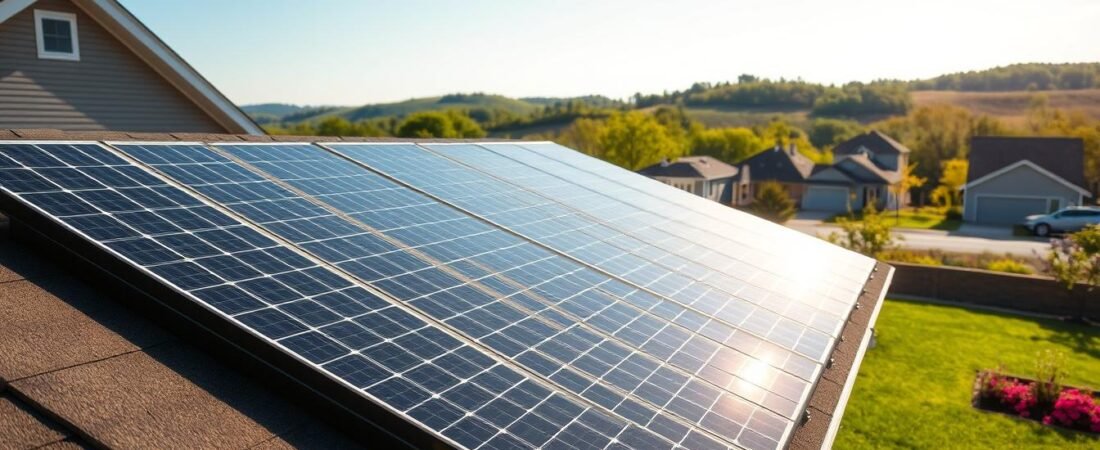
Thinking about clean energy for your home? This guide helps homeowners weigh the numbers and choices. As of April 2026, the average system price sits at $2.53 per watt including installation.
Understanding that figure makes it easier to estimate savings and the likely payback period. Net metering and local incentives can lower your effective price and speed up return on investment.
Whether you plan a cash purchase or a power purchase agreement, this introduction will point you to the key factors: system size, installation, utility rates, and roof suitability. Small steps now can lock in predictable bills and reduce reliance on the grid over the next 25 years.
Understanding Delaware Solar Panel Costs
Your home’s usage patterns and roof orientation are the key drivers of what a system will run.
Start with simple measurements: track monthly electricity use and note which roof sections get the most sun. Those facts shape the system size and the installation price you’ll see.
Many homeowners find that panels create long-term savings by hedging against rising utility bills. Net metering lets you send extra energy back to the grid, improving payback and lowering your monthly bill over the years.
- Local companies can assess roof tilt and shading to recommend high-efficiency modules.
- Compare multiple quotes to make sure your investment is optimized for your home and power needs.
- Check available incentives early — they often change and affect overall price.
“Solar can lock in decades of predictable energy costs and reduce exposure to utility hikes.”
For a local pricing reference, see solar panel pricing in DE to compare estimates from nearby companies.
Average Pricing and System Size Considerations
Start by translating per-watt quotes into real household numbers to see how much system capacity you really need.
Cost per watt is the easiest way to compare bids. It shows how equipment and labor scale as system size grows. Use that metric to check whether a larger installation gives bulk savings on panels and hardware.
Cost Per Watt Explained
Per-watt pricing converts a bid into a standard number you can compare across companies. For a quick reference, the current average price sits near $2.53 per watt including installation.
Impact of System Capacity
System capacity drives total investment. The average system size is 14.54 kW and typically costs about $36,760 before incentives. Prices can range from $31,246 to $42,274 depending on equipment and labor.
- A 5 kW solar panel system usually costs roughly $12,642 — a good fit for smaller homes.
- A 10 kW system often runs about $25,283 and better supports larger electricity needs.
- Analyze past bills and local utility rates to choose a system size that shortens your payback period and boosts long-term savings.
Key Factors Influencing Your Total Investment
The gear you choose—modules and inverters—directly affects how much you pay and how much energy you get.
Module efficiency matters. Monocrystalline models are the most efficient and common today, while older polycrystalline options deliver lower output and are rarely installed now.
Equipment Efficiency and Inverter Types
The efficiency of your solar panels determines how many units you need to meet household electricity demand. Fewer, higher-efficiency panels can cut roof clutter and may reduce labor and installation time.
Inverters turn generated DC into usable AC for your home. String inverters, microinverters, and power optimizers each offer trade-offs in price, monitoring, and long-term performance.
- Choosing efficient modules lowers the total investment and can improve long-term savings.
- Professional installers will assess your roof and recommend the right system size for max production.
- Compare equipment options from multiple companies to balance upfront price with 25-year performance.
“Better equipment choices reduce the number of panels needed and improve energy yield over years.”
For a local pricing guide and to compare per-watt estimates, see local pricing guide.
Financial Incentives and Tax Credits
Federal and local programs can shrink your upfront bill and speed up payback for a new system.
The federal investment tax credit (ITC) currently covers 30% of the value of a solar panel system. Claim the credit on your taxes the year after installation to reduce net price and improve payback time.
While there is no state-specific tax credit here, many local rebates and utility incentives can be stacked with the ITC. That combo often saves homeowners thousands over the system’s lifetime.
“Understanding incentives is key to calculating true investment and long-term savings.”
- Leases or power purchase agreements may pass tax-credit value to customers via lower rates.
- Check program rules for eligibility, the year the credit applies, and required paperwork.
| Incentive Type | Who Claims | Typical Impact |
|---|---|---|
| Federal ITC (30%) | Homeowner or eligible owner | Reduces tax liability; lowers net price |
| Local rebates | Homeowner | Immediate rebate or utility credit |
| Lease/PPA benefits | Provider/Customer share | Lower upfront cost; credits may be passed through |
Tip: Research incentives in 2026 before you sign. Knowing available rebates, the ITC timeline, and how providers treat credits helps you choose the best system size and installation plan for your home and energy needs.
Comparing Financing Options for Homeowners
Choosing a financing path shapes both your monthly budget and the lifetime value of a home energy system. Pick the route that matches your cash available, tolerance for debt, and long-term goals.
Cash Purchases
Paying with cash gives the highest long-term savings. You avoid interest and often see the fastest payback over 25 years.
For many homeowners, a cash purchase also simplifies claiming the federal incentives and reduces ongoing paperwork.
Solar Loans
Loans let you own the system without all the upfront money. Monthly payments replace a lump sum and can match or beat current electricity rates.
Compare interest rates and loan terms carefully—rates affect total costs and net savings over time.
Leases and Power Purchase Agreements
Leases and power purchase arrangements offer low or no money down. They let you use renewable energy with minimal upfront risk.
However, they usually deliver lower lifetime savings than ownership and may limit eligibility for some incentives.
“Weigh loan rates, expected electricity savings, and incentives to choose the best path for your home.”
- Cash: Max savings, no interest.
- Loan: Ownership with monthly payments.
- PPA/Lease: Low upfront cost, less total savings.
Evaluating the Long-Term Savings Potential
Look at lifetime figures, not just the upfront price. Homeowners can expect average savings of about $49,061 over 25 years when they add solar panels to a typical home.
That projection assumes a system life measured in decades and local incentives like net metering. The typical payback period is roughly 12.4 years.
- Real return: After the payback period, the system delivers mostly free electricity for the remaining years.
- Rate protection: Locking in energy production shields your budget from rising utility rates and unpredictable bills.
- Best ROI: A cash purchase usually yields the highest investment return by avoiding loan interest.
- Net metering: Crediting excess power produced increases total long-term savings.
“Model long-term bills and incentives to see if the investment meets your goals.”
Use these numbers to compare quotes and pick a system sized for your household needs and financial goals.
Selecting the Right Solar Installer
Choosing the right installer shapes how well your system performs for decades. A good crew does more than mount panels; they ensure proper wiring, effective roof attachment, and clean aesthetics.
Look for companies that are screened and verified. Examples like Integrated Home Energy in Bear and Lumina Solar in Newark show the kinds of local providers homeowners trust. Verified firms provide clear contracts, licensing, and insurance.
Compare at least three quotes to check equipment choices, warranty terms, and expected production. That step often reveals ways to save money and find the best match for your home and electricity needs.
Quality installation includes ongoing monitoring and support. Ask about remote performance tools, response times for repairs, and how incentives or rebates are handled during paperwork and tax season.
“A trusted installer protects your investment and keeps energy production steady over the life of the system.”
| What to Check | Why It Matters | Red Flag |
|---|---|---|
| License & insurance | Protects your home and liability | No proof or vague answers |
| Warranties & monitoring | Ensures long-term production and support | Short or missing performance guarantees |
| Multiple quotes | Helps find best equipment and value | Only one bid or high-pressure sale |
Why Quality Matters Over Lowest Price
Low bids can look tempting, but they often hide short-term thinking. A bargain may mean lower-quality parts or an unstable company that won’t be around for service.
Choose long-term value. Reliable companies deliver correct installation and parts that last the life of the system. That protects your savings and helps you hit the expected payback period.
Think beyond the sticker price. Investing in good panels and skilled crews cuts the chance of early failures and surprise repair bills.
- Look for clear warranties and service promises.
- Verify equipment brand names and installer credentials.
- Compare total cost, not just the headline price.
“Ridiculously low prices may indicate low-quality equipment or an unsustainable business model that could leave you without support.”
| What to Check | Why It Matters | Red Flag |
|---|---|---|
| Equipment brand & specs | Predicts energy output and longevity | Unnamed or generic parts |
| Warranty & service | Protects your home and future repairs | Short or unclear terms |
| Installer track record | Shows reliability and local support | New company with no reviews |
Conclusion
Careful planning and the right financing can make a home energy system pay for itself over time. Start by matching system size to your actual usage and long-term goals.
Compare multiple quotes from trusted local companies to find the best mix of quality and value. Factor incentives and financing to lower net costs and shorten your payback period.
Prioritize reliable equipment and professional installation to protect production and warranty coverage. Good installers optimize panel placement and system monitoring for steady performance.
Ready to move forward? Request quotes, ask about warranties, and choose the option that balances upfront price with long-term gain. A single solar panel decision can shape decades of predictable energy bills.