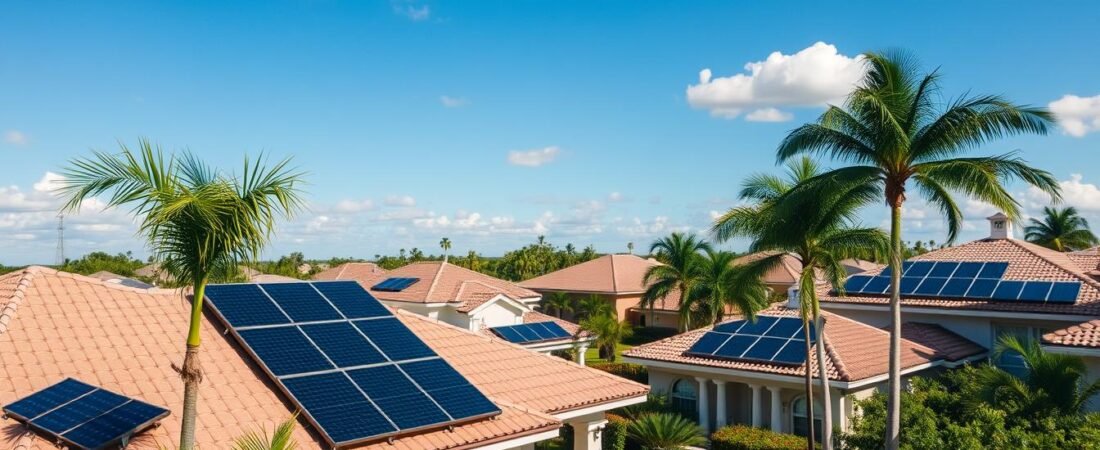
Thinking about a rooftop system for your Florida home? This short guide explains the real price drivers, local rebates, and federal help that cut the upfront investment. You’ll learn how municipal rebates and the 30% federal tax credit can lower your net expense and speed payback.
The City’s Energy Edge program offers a one-time $1,500 rebate, and many homeowners see systems pay for themselves in roughly nine to ten years. With volatile utility rates—up about 26% between 2020 and 2024—switching to clean power can stabilize monthly bills.
Our guide walks through financing, available local incentives, and battery options so you can compare monthly payments to current utility bills. We break down typical system prices after the federal tax credit and show why long-term value often outweighs the initial price.
Understanding the Solar Landscape in Boynton Beach
The local market for residential clean energy has shifted rapidly, and homeowners now see real benefits from lower equipment prices and stronger incentives.
Prices for modules and related equipment dropped about 53% over the last ten years, according to the SEIA. That decline helped Florida climb to second place nationally for residential installations.
The state offers a 100% property tax exemption on added system value through 2037. Net metering also credits exported electricity at full retail rates, which improves long-term value.
More than 250 companies operate here, so shopping around matters. Local roof orientation, shade, and area weather will shape system output and the amount of batteries you may need.
- Falling equipment prices boost affordability.
- Net metering and the federal tax credit strengthen payback.
- Robust competition means better options for installation and financing.
Current Solar Panel Cost Boynton Beach Estimates
Local pricing data shows clear ranges for common system sizes used by Florida homeowners.
Average Cost Per Watt
The average rate in the state sits at $2.71 per watt before incentives. This figure helps you compare bids from different installers and spot unusually high or low quotes.
System Size Pricing
Typical after‑tax prices for common systems are useful benchmarks. A 9 kW system runs about $15,939 after the 30% federal tax credit. Smaller and larger systems scale accordingly: expect roughly $9,072 for 4 kW and $17,640 for 10 kW after the same credit.
Permitting and inspections usually add around 3% to the total installation price. Most homeowners choose a system sized to offset 100% of average energy use to maximize long‑term value.
- Use the per‑watt rate to compare quotes.
- Plan for permits, labor, equipment, and possible batteries when budgeting.
- Get at least three quotes to evaluate pricing, warranties, and financing options.
How Florida Solar Costs Compare Nationally
Market competition and local demand have pushed Florida rates for residential systems below U.S. norms. Floridians typically pay about $1,000 less for equipment than the average American homeowner.
After the federal tax credit, a 9 kW setup averages roughly $15,939 in Florida versus the U.S. average of $16,758. That gap reflects both fierce local competition and lower regional pricing.
Electricity rates in the state also shape the value of an installation. Supply-chain and transmission challenges raise utility bills, which makes switching to rooftop power more attractive for many homeowners.
Choosing to install now can lock in lower prices and help offset rising energy bills driven by fossil fuel volatility.
| Metric | Florida (after tax) | U.S. Average (after tax) | Notes |
|---|---|---|---|
| 9 kW system price | $15,939 | $16,758 | Florida is ~ $819 cheaper per typical install |
| Equipment vs. national | ~$1,000 less | — | Pricing benefits from high local demand and competition |
| Residential ranking | 2nd in nation | Varies by state | Indicates market maturity and installer options |
- Lower local prices mean better value for homeowners comparing installers.
- Compare local bids against national benchmarks to judge warranty and financing terms.
- High market rank and competition help keep equipment and installation affordable.
Financial Benefits of Switching to Solar
Investing in a home energy system today protects you from future utility rate spikes. Rising electricity rates make predictable bills more valuable. In Florida, rates climbed nearly 28% between 2021 and 2023, so locking in lower monthly charges matters.
Projected Energy Savings
A typical 7.2 kW system saves about $130 per month on electricity. Over 9 to 10 years most homeowners reach a full payback, then enjoy many years of low-cost power.
Once the system pays for itself, the average Florida homeowner can expect more than $21,000 in net savings. Over a 25-year lifespan, total avoided utility bills can exceed $50,000.
- Monthly savings reduce dependence on the grid and shield you from rate hikes.
- Net metering combined with the federal tax credit accelerates your return.
- Financing options and solar loans let you start saving without paying the full upfront price.
Comparing Cash Purchases for Solar Systems
Paying cash for a home energy system usually earns the quickest return on investment.
Cash buyers typically see the shortest payback—around 12 years. Without interest payments, a homeowner can save at least $21,632 over a 25-year period in avoided electricity bills.
Keeping ownership from day one also means you claim the full 30% federal tax credit and retain any rebates tied to system and batteries. Avoiding loan interest often preserves thousands in savings that would otherwise reduce long-term ROI.
| Purchase Type | Estimated Payback (years) | 25‑Year Savings | Ownership & Incentives |
|---|---|---|---|
| Cash Purchase | ~12 | $21,632+ | Full ownership; eligible for 30% tax credit |
| Solar Loan | 13–16 | Varies (reduced by interest) | Ownership but interest may reduce net gains |
| Lease / PPA | Not applicable | Lower immediate savings | Provider owns system; limited incentives for homeowner |
- Best ROI: Cash purchases give the highest long-term return if you have the capital.
- Avoiding interest protects savings against rising electricity rates.
- Compare installation warranties and battery ownership before deciding.
Evaluating Solar Loan Programs
Financing options let many homeowners start generating clean energy without a large upfront payment.
Loans and assessment programs make installation accessible. The average monthly payment in Florida is about $270, often offset by lower electricity bills.
Financing Through PACE
PACE lets owners finance systems and batteries via a property tax assessment. There is usually no money down. Repayment follows your tax bill and can transfer with the property in some cases.
Solar Loan Fund Options
The Solar and Energy Loan Fund (SELF) offers low‑interest loans starting at $1,000. These programs aim to keep monthly payments manageable and widen access to clean energy for more households.
| Program | Typical Monthly Payment | Average Payback | Notes |
|---|---|---|---|
| Standard Solar Loan | $270 | ~14 years | May add financing fees; raises cost per watt to ~$3.25 before interest |
| PACE | Varies (tax bill) | Depends on term | No upfront cash; repaid via property tax |
| SELF (nonprofit) | Lower than market | Varies | Designed for affordability; loans from $1,000 |
- Tip: Compare interest, fees, and term length to keep monthly payments affordable.
- Good financing helps you start producing clean energy now while spreading payments over several years.
Understanding Solar Lease Agreements
Choosing a lease means a company owns the equipment while you pay a predictable monthly fee for the energy it produces.
Leases usually require $0 down and replace a variable utility bill with a fixed monthly payment. That makes installation accessible for homeowners who prefer low upfront spending.
Key trade-offs:
- Leases keep monthly payments below typical electricity charges to deliver immediate savings.
- The leasing company retains ownership, so long-term return on investment is lower than buying a system outright.
- Because you do not own the equipment, you cannot claim the federal tax credit or related homeowner incentives.
“Palmetto’s LightReach lease offers a 90% production guarantee and includes all maintenance, simplifying ownership for the homeowner.”
When to consider a lease: If you prioritize immediate cash flow and minimal hassle, a lease can be practical. If you want maximum savings over decades, ownership or a loan usually wins.
Leveraging the Federal Solar Tax Credit
Claiming the federal investment tax credit can shave thousands off your system and battery bills in the year you install. The credit equals 30% of qualified installation expenses, and it applies to both rooftop equipment and eligible battery storage.
To claim the benefit, file IRS Form 5695 with your federal return for the year the system is placed in service. The credit is non‑refundable, but you can carry unused portions forward to later tax years if your liability is lower than the credit.
The 30% rate is available through 2032. It then steps down to 26% in 2033 and 22% in 2034. Standalone battery storage systems with at least 3 kWh capacity also qualify under the Inflation Reduction Act.
- Major advantage: The federal credit cuts a big slice from your upfront investment and improves long‑term returns.
- Make sure invoices clearly separate equipment, labor, and battery charges for accurate reporting.
- Consult a tax professional to confirm eligibility and to correctly complete Form 5695.
“The federal tax credit is one of the most powerful tools to reduce the price of an installation and enhance financing outcomes.”
Local Incentives and Rebates for Boynton Beach Residents
Several municipal incentives in Florida layer with federal help to make clean energy more affordable for homeowners.
Energy Edge Rebate Program
The City’s Energy Edge program awards a $1,500 rebate for qualifying systems of 5 kW or larger that use panels with at least 17.5% efficiency.
Statewide benefits also matter. Florida’s sales tax exemption saves the average homeowner roughly $2,000 on a typical installation. In addition, the property tax exemption covers 100% of the added system value through 2037.
- Combine the $1,500 Energy Edge rebate with the 30% federal tax credit to reduce your net price.
- Other local offers — like Dunedin’s $0.25 per watt grant (up to $2,500) and JEA’s $4,000 battery rebate — show the range of support across the state.
- Confirm efficiency and warranty rules before applying to ensure eligibility.
| Incentive | Value / Limit | Qualifying Notes |
|---|---|---|
| Energy Edge (City) | $1,500 | 5 kW+ systems; ≥17.5% panel efficiency required |
| Florida Sales Tax Exemption | ~6% (avg. $2,000 saved) | Applies to equipment and batteries |
| Property Tax Exemption | 100% through 2037 | Value added by system not taxed |
| Dunedin Grant | $0.25/watt, up to $2,500 | Residential installs; local application required |
| JEA Battery Rebate | Up to $4,000 | Qualifying storage with 10‑year warranty |
“Check program deadlines and documentation — many incentives run out quickly and require proof of installed efficiency or warranty.”
Tip: Verify current funding, then stack local rebates with the federal tax credit and available financing to maximize savings. Our team can help navigate applications and solar loan options tailored to your Florida home.
Key Factors Influencing Your Total Installation Price
System size dominates the final invoice because every added kilowatt needs more equipment and labor.
Roof characteristics then change the work involved. Orientation, pitch, and material—like asphalt or clay tiles—affect mounting choices and time on the roof.
The type of equipment you choose also matters. Higher efficiency modules, inverter style, and integrated batteries raise the upfront price but can improve long‑term energy yield.
Permitting and inspections typically add about 3% to installation costs. Local fees vary, so get permit estimates early to avoid surprises.
Finally, installer quality affects both price and performance. Choosing NABCEP‑certified installers tends to cost more up front but reduces risks and maintenance down the road.
- Primary driver: system size and expected output.
- Roof complexity and material influence labor and mounting hardware.
- Equipment and batteries change both upfront price and long‑term savings.
- Permits add roughly 3%—confirm local rules early.
- Certified installers protect your investment and warranties.
| Factor | Typical Impact | Why It Matters |
|---|---|---|
| System size | High | More modules and wiring increase labor and equipment needs |
| Roof type & orientation | Medium | Alters mounting method, time, and risk of roof repairs |
| Equipment & batteries | High | Efficiency and storage change upfront price and energy value |
| Permits & inspections | Low (≈3%) | Required by local authorities; adds predictable fees |
| Installer credentials | Medium | Experienced teams lower long‑term maintenance and performance issues |
“Plan system size and equipment with installers to match your energy goals and budget.”
Why System Size Matters for Your Energy Goals
Picking the right system size ties directly to how much of your electricity needs you can cover each year. A 9 kW setup suits moderate households, while a 15 kW configuration fits high-usage homes that run many appliances or electric vehicles.
Size affects monthly savings and payback. Systems sized to offset 100% of annual use usually deliver the best return. Undersized installs leave you buying more grid electricity and lengthen payback. Oversizing can hit net metering limits and reduce proportional value.
Roof space and shading set real limits. Available square footage, roof pitch, and trees will dictate the largest viable installation. Batteries add flexibility but also raise the price and require extra roof or garage space for equipment.
| Metric | 9 kW | 15 kW | Recommendation |
|---|---|---|---|
| Typical use | Moderate household | Large home / EV charging | Match to annual electricity use |
| Best for | Most 2–4 person homes | 5+ person homes, high loads | Offset 100% of annual consumption |
| Risk | May underproduce if usage grows | May exceed net metering value | Balance size with roof and finance |
We review past bills to size systems that meet goals and support your financing choices. Proper sizing is the foundation of an efficient, cost-effective installation.
Selecting the Right Solar Equipment for Florida Weather
Choosing equipment that handles heat, wind, and rain is the single best step to protect your rooftop investment in Florida.
Pick components with proven durability so your installation keeps producing through storms and heavy humidity.
Panel Efficiency
High-efficiency modules deliver more energy per square foot, which helps if roof space is tight or partially shaded.
They cost more up front but may reduce the number of modules you need. That can lower roof complexity and speed installation.
Durability for Hurricanes
Choose brands known for wind resistance. REC, for example, is respected for strong frames and rigorous testing in high-wind zones.
Durable racking and tempered glass cut the risk of storm damage and lower long-term repair needs.
Battery Storage Considerations
Batteries give backup power when the grid goes down — common after tropical storms. Plan capacity around critical loads like refrigeration and medical devices.
Microinverters are another smart choice. They boost system performance and isolate shading problems, though they raise initial price.
- Balance premium equipment with your budget and long-term goals.
- Factor warranties and expected hurricane ratings into decisions.
- Consider batteries if outage protection matters for your home.
“Well-chosen equipment keeps systems producing clean energy after years of Florida weather.”
| Choice | Benefit | Note |
|---|---|---|
| High-efficiency modules | More output per area | Higher price, saves space |
| REC or similar brands | Improved wind resistance | Good for hurricane-prone areas |
| Batteries + microinverters | Backup power; better module-level performance | Raises upfront price; boosts reliability |
Maintenance and Long-Term Care for Your System
Simple maintenance tasks and timely inspections protect your investment and keep electricity yields steady.
Most systems are largely fuss-free. Florida rain helps wash away pollen and dust, so routine cleaning is rarely needed.
If you replace your roof, expect professional removal and reinstallation fees of about $500–$1,000. Plan for that expense when budgeting long-term.
- Schedule periodic inspections with your installer to spot issues early.
- After storms, have a pro check for debris and structural damage before restarting the array.
- Keep batteries and inverters clear of standing water and vegetation.
“Regular checks and clear warranty records make repairs faster and reduce out-of-pocket surprises.”
| Task | Frequency | Typical Cost |
|---|---|---|
| Visual inspection | Annually | Often free with service plan |
| Professional cleaning | As needed (rare in FL) | $0–$150 |
| Removal/reinstall for roof work | Per roof replacement | $500–$1,000 |
Understand your warranty and keep invoices handy. That lowers repair risk and protects long-term energy savings.
For repairs or inspections, consider trusted local repair services like solar repair services to keep your system running at peak performance.
Choosing a Reliable Solar Installer
Picking the right installer makes a big difference in how smoothly your project runs and how much energy you actually produce.
Start by getting at least three quotes from local companies. Florida has over 250 firms, so comparison helps you spot fair pricing and strong warranties.
Look for firms that have operated five years or more and use their own installation crews. That reduces subcontractor risk and keeps quality consistent.
Check for NABCEP-certified technicians. Certification signals a team that follows industry best practices and safety standards.
- Read customer reviews on sites like SolarReviews to verify communication and support.
- Confirm the installer handles permits, HOA approvals, and utility coordination.
- Ask for references, warranty details, and a breakdown of financing and any applicable tax credits.
| What to Check | Why It Matters | Red Flags |
|---|---|---|
| 5+ years in business | Proven track record and local experience | New companies with no local refs |
| Own crews & NABCEP certification | Consistent installs and certified expertise | Subcontracting without oversight |
| Handled permitting & HOA | Smoother timeline; fewer delays | Installer avoids paperwork or vague timeline |
| Clear financing and tax guidance | Maximizes incentives and manages payments | No written financing terms or incentive breakdown |
Tip: By comparing multiple bids you can often save up to 20% while ensuring quality. A trusted partner will manage logistics, advise on batteries and systems sizing, and make installation straightforward for your home.
Conclusion
Smart planning—right size, reliable equipment, and proper financing—makes clean energy a practical choice for many homeowners. Choose a system that matches your usage, compare multiple bids, and factor in available rebates and the federal tax credit to lower net expenses.
Proper equipment and batteries protect production through storms and give you backup when the grid goes down. Whether you pay cash or use a loan, good financing terms speed payback and increase lifetime value.
Request multiple quotes, check warranties, and pick an installer with local experience. With careful planning, your systems will deliver years of reliable power, higher home value, and predictable monthly bills—so start exploring options today.