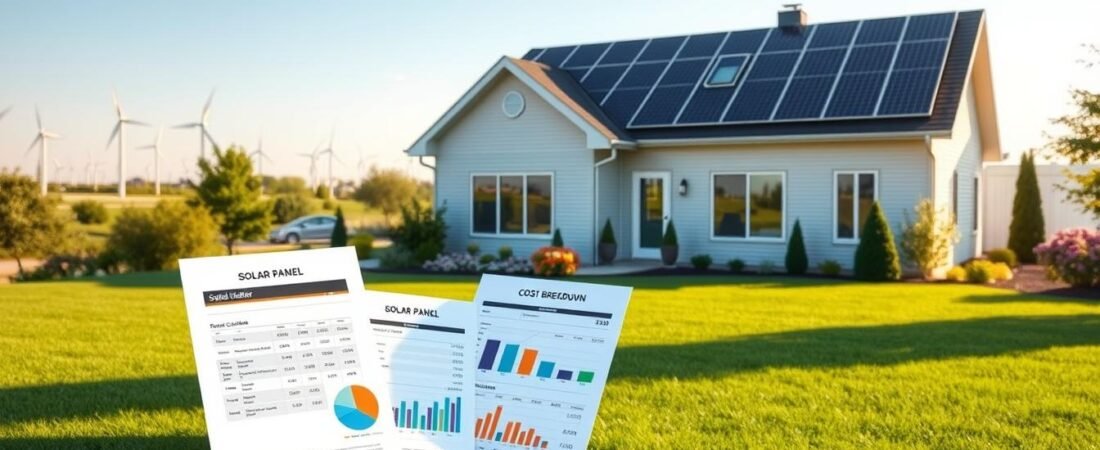
Thinking about a home energy upgrade? This guide gives clear numbers and simple steps to help homeowners weigh their options. As of April 2026, the average system price is $2.93 per watt with installation, and a typical 12.57 kW setup runs about $36,762 before incentives.
Expect long-term benefits: average savings on electricity total about $30,532 over 25 years. Most systems last 25–30 years, so you lock in predictable energy bills and guard against rising utility rates.
Key figures matter: the typical payback period sits near 12.81 years. That helps you judge whether a cash purchase, loan, or power purchase agreement makes sense for your budget.
Read on to learn how system size, roof orientation, local tax credits, and optional storage affect final price and payback. This quick intro sets the stage for a data-driven look at installation options and long-term savings.
Understanding the Solar Panel Cost in Illinois
Breaking the numbers into clear parts reveals where most expense comes from.
Average price: The typical rate sits at $3.15 per watt as of 2026. That figure reflects equipment, labor, permits, inspections, and installer margin.
After the 30% federal tax credit, a 7.2 kW system costs roughly $15,876. Homeowners should view that as the out-the-door price after incentives.
- Monocrystalline panels are the common choice for residential projects due to higher efficiency.
- Polycrystalline types are less efficient and rarely chosen today.
- Final savings depend on how much of your monthly electricity the system offsets.
| Item | Typical Value | Notes |
|---|---|---|
| Price per watt | $3.15 | All-in installed |
| Example 7.2 kW system | $15,876 | After 30% federal tax credit |
| Common module type | Monocrystalline | Higher efficiency, widely used |
| Included costs | Permits, inspection, labor | May vary by installer |
Current Market Trends for Residential Solar
Rising utility bills and shifting policies are reshaping homeowner choices across the state.
Rising Electricity Rates
From 2020 to 2024, electricity prices jumped about 22% across the state. That surge has pushed many homeowners to consider alternatives to steady utility bills.
Chicago saw rates climb from 13.2¢ per kWh in 2021 to 15.9¢ in 2024. ComEd customers face rates that reflect grid demand and policy shifts.
Regional Adoption Trends
Adoption is climbing: the state ranks 12th nationally for residential installations. Neighborhoods now often list home generation as an efficiency feature.
Why this matters: local uptake helps lower installer lead times and improves access to higher-quality systems. Over 25 years, that can mean meaningful savings for many families.
| Metric | Value | Note |
|---|---|---|
| Price increase (2020–2024) | 22% | Drives interest in home systems |
| Chicago rate (2024) | 15.9¢/kWh | Up from 13.2¢ in 2021 |
| National rank (residential) | 12th | Growing regional adoption |
How System Size Impacts Your Total Investment
How big your system needs to be will shape both upfront price and long-term savings. A 5 kW setup in the state runs about $14,627, while a 10 kW system is roughly $29,253. Doubling capacity almost doubles the total investment, though larger installs often lower the per-watt rate.
Your home’s energy use and roof area determine how many panels fit and how much electricity you can offset. A 10 kW array can power about 3.6 average homes in July or run a heating system for roughly 15 hours in December.
Roof angle and sun exposure matter. Orientation, shading, and local climate affect annual production and the real value of added capacity.
- Assess usage: Review recent bills to size a system that matches your goals.
- Check roof space: Some roofs can handle larger systems; others limit expansion.
- Think long-term: A bigger setup can increase lifetime savings if your roof supports it.
For a detailed breakdown of typical pricing and examples by system size, see the current Illinois pricing guide.
Key Factors Influencing Your Installation Price
Several key items — from inverters to permits — drive the final invoice for any home install.
Equipment Quality
Higher-grade modules and grid-interactive inverters raise the sticker price but unlock rebates and better long-term output.
Top-tier gear often carries longer warranties and better efficiency over a 25-year lifespan.
Permitting and Soft Costs
Permits, inspections, and installer margins vary by town and company. Chicago offers the Green Permit and Solar Express routes to cut these soft costs and speed approvals.
Home Energy Usage
Your electricity needs set the required system size. Larger systems require more modules and boost the total price.
- Compare quotes: Low bids may use cheaper equipment.
- Plan for storage: Batteries raise upfront spend but improve resilience.
- Fit to roof: Proper design maximizes lifetime value.
| Factor | Impact | Note |
|---|---|---|
| Equipment quality | High | May qualify for incentives |
| Permits & soft costs | Medium | Varies by municipality |
| Home usage & size | High | Directly drives system scale |
Navigating Federal and State Solar Incentives
A mix of tax credits, utility rebates, and local programs can change the math on an installed system.
The federal tax credit covers 30% of the installed value for eligible renewable energy systems. That reduction directly lowers what homeowners owe at tax time and shortens the payback period.
The Illinois Solar for All (ILSFA) program provides no-upfront installations for income-qualified households. The 2025–2026 budget is $186.3 million to expand access for lower-income residents.
ComEd and Ameren customers can claim a Distributed Generation rebate. That pays $300 per kW for generation and $300 per kWh for battery storage.
File the PTAX-330 form to freeze your property tax assessment at pre-installation levels. This protects your home from higher property taxes caused by added value from an installed system.
| Incentive | Benefit | Notes |
|---|---|---|
| Federal tax credit | 30% of installed value | Reduces tax liability for homeowners |
| Illinois Solar for All | No upfront installation | Income-qualified applicants, $186.3M budget |
| Utility rebates | $300/kW and $300/kWh | ComEd & Ameren customers |
New net metering rules (2025) credit excess generation at the supply-only rate for new systems. Also, the CRGA Virtual Power Plant program launching by June 2026 will pay owners for battery dispatch performance.
Tip: Combine credits, rebates, and the PTAX-330 to lower upfront payments and protect long-term savings. Talk to your installer or a tax advisor to lock in available incentives before you sign an agreement.
Exploring Financing Options for Your Home
Choosing how to pay for a home energy system shapes both your short-term budget and long-term savings.
Cash purchases deliver the largest lifetime savings. Pay once, own the system outright, and claim the tax credit directly.
Cash Purchases vs Loans
Loans let homeowners spread payments and often offer $0-down options. That makes systems accessible while you still earn immediate electricity savings.
Tip: A loan can raise monthly costs early but still beat utility bills over years if your rates rise.
Solar Leases and Power Purchase Agreements
Leases and PPAs mean the provider owns the equipment. You pay for actual production at a fixed rate per kWh.
Programs like Palmetto’s LightReach operate this way in Illinois. They handle maintenance and allow owners to avoid upfront money and upkeep.
- Cash = biggest long-term savings, highest upfront spend.
- Loan = spread payments, keep incentives, immediate savings.
- PPA/lease = low upfront money, predictable power purchase rate, no ownership.
| Option | Ownership | Best for |
|---|---|---|
| Cash | Owner | Max long-term savings |
| Loan | Owner | Low upfront, keep tax credit |
| PPA/Lease | Provider | Low upfront, maintenance-free |
Review terms closely to avoid hidden fees or early-termination penalties. Compare offers and pick the path that fits your budget and energy goals.
The Role of Battery Storage in Modern Systems
Storing excess energy at home gives you backup power and new ways to earn. Batteries let homeowners keep midday generation for use at night or during outages.
New utility programs and rebates make adding batteries more attractive than before. The CRGA Virtual Power Plant program starts by June 30, 2026, and will pay owners for grid support.
ComEd also offers a $300 per kWh rebate for battery systems. That rebate can pair with federal tax credits to lower upfront expense.
- Integrating battery storage boosts home resilience and reduces peak-hour grid dependence.
- Grid-interactive inverters are required to join many dispatch and virtual plant programs.
- Storage for All aims to give income-qualified households access to modern battery tech.
| Feature | Benefit | Note |
|---|---|---|
| Battery rebate | Lower upfront price | ComEd: $300/kWh |
| Virtual Power Plant | Earn for grid support | CRGA launches by 6/30/2026 |
| Grid-interactive inverter | Enables dispatch | Required for many programs |
Bottom line: Adding batteries to your system improves reliability and opens new revenue paths for homeowners. Investing now prepares your home for future power programs and smarter energy use.
Comparing Quotes from Local Installers
Collecting multiple offers exposes differences in equipment, warranties, and estimated output. Get at least three written quotes to compare price, timeline, and terms.
Use a marketplace like EnergySage to gather vetted bids and side-by-side comparisons. That tool can speed the process and help you save up to 20% through competition.
Look for reputable names serving the state—Next Solar, SunPower Inc., All Energy Solar, Certasun, and Eagle Point Solar often appear in local listings.
“A transparent quote shows equipment, permitting, expected performance, and warranty details.”
Screen installers: check reviews, ask for local references, and confirm licensing and insurance. A clear cost breakdown helps you compare true value, not just the lowest price.
- Compare financing offers and designs to match your system goals.
- Remember local firms know regional incentives, permitting, and net metering rules.
- Prioritize quality and long-term support over a quick bargain.
Long Term Financial Benefits of Going Solar
A residential energy system can boost property value while trimming annual expenses. Homeowners get both steady energy savings and protections that keep those gains secure.
Property Tax Exemptions: File the PTAX-330 to freeze your home’s assessed value and avoid higher tax bills from added value after installation.
Typical installations raise resale value by about 5–10%. With an average property tax rate of 2.07%, that exemption can save hundreds each year.
- Lifetime savings: The exemption is estimated to save roughly $13,351 over a system’s life.
- Avoided utility costs: A 7.3 kW system can produce about $57,382 in electricity savings over 25 years.
- Payback: Average payback is near 12 years, then the system delivers mostly free power for the remaining years.
“Locking in exemptions and combining rebates with the federal tax credit makes this one of the smartest home investments available.”
| Benefit | Estimate | Note |
|---|---|---|
| Property tax savings | $13,351 | Over system life |
| Avoided utility costs | $57,382 | 7.3 kW over 25 years |
| Home value bump | 5–10% | Depends on system size and roof efficiency |
Bottom line: Combine state rebates, the federal tax credit, and the PTAX-330 to secure stronger long-term savings and a faster return on your investment.
Conclusion
Choosing a home generation system today locks in stable bills and shields you from future price swings.
Take advantage of federal credits and local incentives to lower overall cost and shorten payback time. Compare quotes from vetted installers to secure the best installation and equipment for your roof and needs.
Remember that long-term savings often outweigh the initial price. Property tax exemptions and utility programs further improve value and protect your investment.
Ready to learn more? See the solar panel Illinois guide for tailored details and next steps.