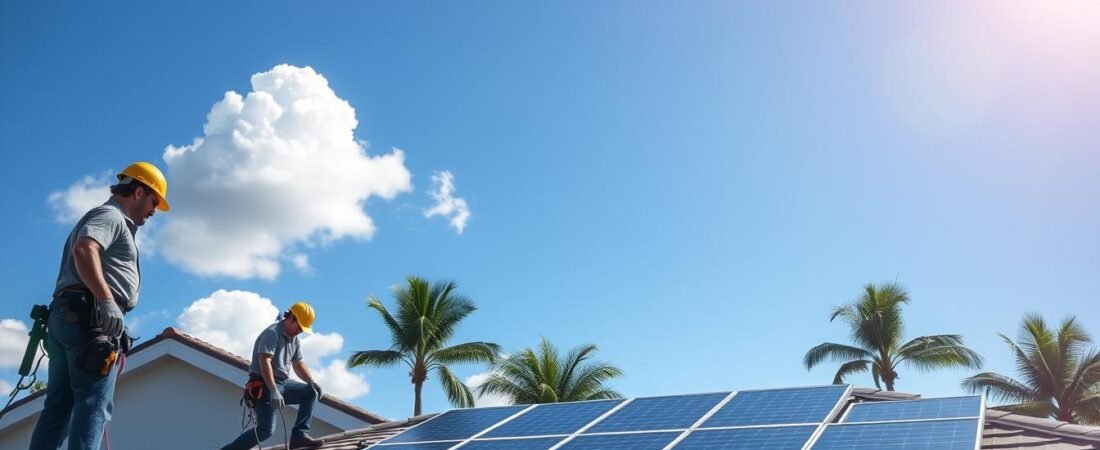
The Sunshine State offers a unique chance for homeowners to cut energy bills and boost property value. Our guide simplifies the search for local installers and helps you pick trusted partners for a long-lasting system.
We analyze real customer ratings and expert criteria to highlight firms that deliver quality equipment, smooth installation, and strong warranties. Finding the right solar company is the most critical step toward reliable electricity for decades.
Compare quotes, check service history, and ask about roof work and local incentives before you commit. Our team focuses on experience, pricing, and customer support so your transition to renewable energy is clear and manageable.
Start here to learn how top installers earn high marks for service, savings, and technical know-how. Use this short guide to ask the right questions and feel confident about going solar at your home.
Why Florida is the Ideal State for Solar Energy
Thanks to roughly 230 sunny days each year, homeowners can reliably capture daylight to lower utility costs. The state averages about 5 to 6 peak sun hours daily, which boosts daily electricity production and shortens payback times for home systems.
Resilience matters: many local systems are engineered to withstand hurricane-force winds, so arrays stay secure during severe weather. Choosing an experienced installer helps ensure the system performs well across the years and matches local codes.
Growing local expertise means more trained crews understand roof loads, permits, and how to optimize output for our climate. That knowledge improves long-term results and reduces surprises after installation.
If you want a guided start, learn about trusted options and services at professional installation services. Planning with a reputable company helps you turn abundant sun into dependable savings.
How to Evaluate Solar Panel Companies in Florida
Choosing the right installer starts with a few focused checks. Look first at ratings, response time, and whether a provider explains total costs clearly. These clues show how the team treats customers after the sale.
Customer Review Scores
Customer Review Scores
Check Google and Yelp scores and read recent comments. Pay attention to notes about installation timing, cleanup, and follow-up service.
Years of Experience
Years of Experience
Prefer firms with at least five years experience. Longer tenure usually means established warranty support and steady after-sales services.
- Confirm licensing and insurance for roof work.
- Ask for clear quotes that list total cost and expected savings.
- Compare multiple bids to evaluate pricing and equipment offered.
| Criterion | What to look for | Why it matters |
|---|---|---|
| Ratings | 4+ stars on major platforms | Shows consistent customer service and timely installs |
| Years experience | 5+ years | Indicates reliable warranties and trained crews |
| Quotes | Detailed, itemized pricing | Helps compare cost, equipment, and long-term savings |
Essential Credentials for Your Solar Installer
Start by making sure your chosen provider has the right licensure and proven field experience. Proper credentials protect your roof, your wallet, and the long-term performance of your system.
Licensing and Insurance Requirements
State rules are strict for good reason. In this state, a certified contractor (CV) license is mandatory for any installer to work legally. The license requires at least four years of field experience and passing a trade exam plus a Business and Financial Management test.
Make sure the company carries adequate liability and workers’ insurance. Also look for NABCEP-certified staff, clear workmanship warranties, and transparent documentation about pricing and incentives.
- Confirm CV licensure and exam records.
- Ask for proof of insurance and warranty terms.
- Check experience, ratings, and customer service responsiveness.
| Credential | Requirement | Why it matters |
|---|---|---|
| Certified contractor (CV) | Mandatory; 4+ years experience | Ensures legal compliance and trained crews |
| Exams passed | Trade & Business/Financial Management | Shows technical and business knowledge |
| Insurance & warranty | Liability, workers’ comp, workmanship warranty | Protects your roof and limits your cost risk |
| Third-party certs | NABCEP or similar | Independent proof of installer skill |
Understanding Solar Financing and Payment Options
Financing choices shape your long-term savings and can make installation affordable today.
Most homeowners use loans to pay over time. Loans let you own the system and claim tax incentives. Ask the installer for any dealer fees that may be added to the loan amount.
If you don’t qualify for credit, a lease or power purchase agreement (PPA) provides another route. These let you pay monthly for energy without owning the equipment. Review any escalator clauses closely to ensure yearly increases stay below utility rates.
Get clear payback info from each company. A reputable provider will show expected savings, warranty length, and total cost over the term. Compare quotes side‑by‑side to spot hidden fees and to find the best option for your home.
| Option | Best for | Key notes |
|---|---|---|
| Loan | Owners who want incentives | Own system, get tax credits, check dealer fees |
| Lease / PPA | Low credit or no tax liability | Lower upfront cost, watch escalator clauses |
| Cash purchase | Those seeking fastest payback | Highest upfront cost, maximum lifetime savings |
| Third‑party financing | Customers seeking flexible terms | Compare pricing and warranty transfer rules |
Talk with your installer about the payback period, warranty coverage for panels and equipment, and any local incentives. That guidance helps you pick the best plan for your budget and long-term savings.
The Role of Solar Batteries in Florida Homes
Energy storage turns brief production peaks into reliable electricity for routine use and emergencies. A battery stores excess daytime output so your home can draw power at night or during outages.
Benefits of energy storage
- Many top solar companies recommend adding a battery to provide steady electricity when the grid is unstable.
- Storage improves overall system value by capturing surplus generation and increasing self-consumption.
- Installers with years of experience can match battery equipment to your home’s needs and roof layout.
Backup power during storms
Batteries offer peace of mind during severe weather by keeping essentials running. Even if you don’t save much on bills, the safety and convenience can be worth the cost.
| Feature | Why it matters | Ask the installer |
|---|---|---|
| Backup duration | How long lights and fridge stay on | Expected hours at typical load |
| Integration | Seamless operation with your existing system | Compatibility and installation experience |
| Warranty | Protects battery lifespan and performance | Length and coverage details |
| Cost vs. savings | Payback timeframe and incentives | Upfront cost, rebates, and long-term savings |
Navigating Federal and State Solar Incentives
Smart use of federal tax credits and state programs can lower the net price of a home energy system dramatically. The current federal credit reduces taxes by 30% for homeowners who buy panels or battery storage. That break can cut a large slice off your installation cost.
State incentives add more value. In our state, property tax abatement keeps the added home value from increasing your property tax bill. Net metering credits let homeowners earn value for excess energy sent back to the grid.
Choose a reputable company or installer that explains how these incentives apply to your case. Ask for clear quotes that show the federal 30% credit, any property tax abatement, and expected net metering credits. A knowledgeable company with years of experience will also outline how incentives affect your warranty and long‑term savings.
- Confirm the 30% federal credit applies to panels and batteries you buy.
- Request quotes that itemize incentives and net metering estimates.
- Ask how incentives change total cost florida residents will pay and warranty terms.
What to Look for in Professional Solar Quotes
Make the comparison simple: focus first on system size, expected yearly energy, and per‑watt pricing so you can compare apples to apples.
Analyzing System Size and Energy Production
System size and projected kWh should appear clearly on every quote. The vendor should list the number of panels, total kilowatts (kW), and estimated annual electricity output.
Look for per‑watt pricing that aligns with local norms — typically $2.06 to $3.10 per watt. Make sure the quote explains assumptions on shading, orientation, and local weather that affect production.
A trustworthy company provides both a cash price and a financed option. Ask for a breakdown that shows dealer fees; these can add 20% or more to loaned cost.
- Get at least three quotes to compare equipment, warranty, and pricing.
- Ask why one installer sized the system differently than another; differences often come from production estimates or panel efficiency.
- Request a payback calculation so you see expected savings over time.
| Quote Item | What to expect | Why it matters |
|---|---|---|
| Price per watt | $2.06–$3.10 | Standard range for cost comparison |
| System capacity | kW and panel count | Determines approximate yearly kWh |
| Dealer fees | Shown separately | Can increase financed cost by 20%+ |
Comparing Equipment Quality and Panel Efficiency
Start by weighing module wattage and efficiency ratings. Most modern panels are around 400 watts and now commonly exceed 19% efficiency. Those numbers matter because they shape how much energy your roof will produce each year.
Ask each installer to name the brands they supply and to show datasheets for modules, inverters, and racking. A transparent company will explain performance curves, temperature coefficients, and expected degradation over time.
Industry standard warranties run about 25 years for product and performance. Confirm the exact terms and ask how the warranty handles hail, water intrusion, and labor for replacements.
- High-efficiency modules usually cost more but deliver more kWh per square foot, which helps smaller roofs.
- Check that inverters and mounting hardware are rated for coastal winds and salt air to protect your roof and investment.
- Compare equipment lists between quotes to balance upfront cost and long-term output for your home system.
For a quick shortlist, review offers from top-rated providers and use that comparison to choose the best solar company for your needs. See local options at top-rated providers.
The Typical Solar Installation Timeline
A clear timeline keeps projects predictable and stress low. The full solar installation often spans several weeks for permitting and equipment delivery, but the physical install usually takes one to three days.
Common steps:
- Site visit at your home to map roof layout and shade.
- Permitting and equipment orders handled by the selected company.
- On-site work: racking, wiring, inverter setup, and panel placement.
- Local government inspection and final interconnection approval.
Top installers with years of experience coordinate inspections and final testing so your system goes live smoothly. The best solar firms also communicate timelines clearly and answer questions during each phase.
| Step | Typical duration | Who manages it |
|---|---|---|
| Site survey | 1–3 days scheduling | solar company representative |
| Permits & orders | 1–4 weeks | Project manager at the company |
| Physical install | 1–3 days | Certified installers and electrician |
| Inspection & activation | Few days to 2 weeks | Local inspector and installer |
Expert Tips for Long-Term System Maintenance
Routine checks and small repairs keep your home energy system running reliably for years.
Monitor production daily or weekly with your system app. Early detection of drops lets an experienced company respond before damage grows.
Keep modules clean and free of debris. Light dirt reduces output more than many owners expect.
- Schedule professional inspections every 1–2 years to verify roof mounts and wiring.
- Confirm a workmanship warranty with your installer to cover installation damage.
- Contact your company promptly for unexplained production declines.
“Regular maintenance is the best investment to protect your warranty and ensure steady energy returns.”
| Task | Frequency | Benefit |
|---|---|---|
| Visual inspection | Annually | Find loose mounts or shading issues |
| Cleaning | As needed (1–2× per year) | Restore peak energy output |
| Performance review | Quarterly | Spot drops and trigger service calls |
Conclusion
Choosing the best solar companies and a trusted installer is a vital step toward long‑term savings and greater home energy independence. Review ratings, compare detailed quotes, and confirm licensure before you commit.
Focus on quality: match equipment and warranty terms so your system and panels deliver steady performance. Take full advantage of available incentives to lower upfront cost and speed payback.
Pick a responsive team that offers clear pricing, solid customer service, and guidance from design through final inspection. With the right expert, your installation will protect savings and keep electricity reliable for years.