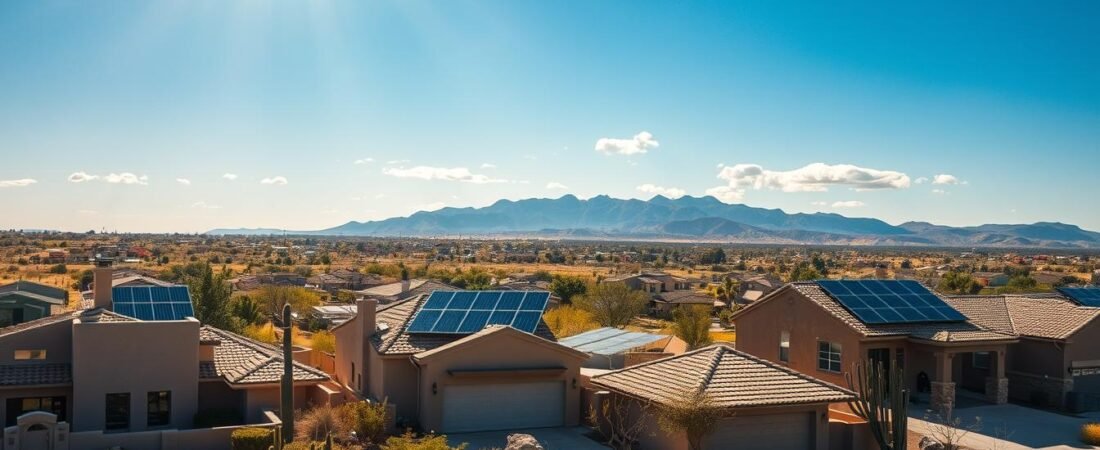
Utility bills climb each year. For many homeowners in Albuquerque, keeping monthly expenses steady feels impossible. A local rooftop option can help lock in more predictable energy payments.
What does “solar panel cost Albuquerque” include? Typically it covers hardware and installation. Smart shoppers compare both the price per watt and the total system price to judge value.
As of February 2026, local benchmarks sit around $2.84–$2.88 per watt, with an average system of about 9.22 kW and a pre-incentive price near $26,608 (range ~$22,617–$30,599). Different quotes will vary by installer, system size, and assumptions.
This guide looks beyond the sticker price to show net cost after incentives, payback timelines, and long-term savings. Remember that these systems often last 25–30 years, so installer quality and warranty support matter nearly as much as upfront price.
Read on for real-world price snapshots, what installation includes, key cost drivers, incentive basics, and financing options. Local and federal programs change, so verify current rules when you request quotes.
Albuquerque solar prices in 2026: what homeowners are paying now
In early 2026, Albuquerque homeowners are seeing installer quotes that average just under $3 per watt.
Why per-watt matters: Installed pricing is commonly shown in dollars per watt so buyers can compare offers on an apples-to-apples basis.
Average installed price per watt: about $2.84–$2.88/W
Benchmark range: Local data clusters around $2.84–$2.88 per watt. That small spread reflects timing, equipment choices, and installer pricing models.
Typical total cost for a market-average system before incentives
A market-average solar panel system in Albuquerque is roughly 9.22 kW. At current rates that translates to about $26,608 before incentives.
Most quoted totals fall between roughly $22,617 and $30,599. Upfront totals can feel high, but this is a decades-long purchase that reduces lifetime electricity bills.
- Quoted totals vary by roof complexity, panel orientation, and electrical upgrades.
- Ask installers for both a cash price and a financed total so you can compare true costs.
| Metric | Typical Value | Range |
|---|---|---|
| Installed price (per watt) | $2.84–$2.88/W | $2.84–$2.88 |
| Market-average system size | 9.22 kW | — |
| Pre-incentive total | $26,608 | $22,617–$30,599 |
Next up: system size is the biggest driver of total price. Even when per-watt declines for larger installs, the total remains higher for bigger systems.
solar panel cost albuquerque by system size: real-world price benchmarks
Your home’s energy use should guide system size. A 7.2 kW example and the market-average ~9.22 kW give two practical anchors for quotes and expected yearly power production.
Real-world examples:
Typical 7.2 kW — roughly $14,314 after a 30% federal tax credit.
Market-average ~9.22 kW — about $26,608 before incentives.
Common size snapshots (gross prices)
| Size | Estimated pre-credit price |
|---|---|
| 3 kW | $8,654 |
| 4 kW | $11,539 |
| 5 kW | $14,424 |
| 6 kW | $17,308 |
| 7 kW | $20,193 |
| 8 kW | $23,078 |
| 9 kW | $25,962 |
| 10 kW | $28,847 |
Even a 1 kW change (for example 5 kW → 6 kW) shifts totals materially. That matters if you aim to cover a larger share of your usage.
Why bigger systems can be cheaper on a per watt basis: installers get volume discounts and fixed fees spread over more equipment. Still, totals rise because you add more modules, racking, and labor.
Compare both per watt and total price when you get quotes. Quoted totals include permitting, labor, interconnection, and warranty service — all of which affect end costs and long-term value.
What’s included in an installation price (and what’s not)
A thorough estimate separates hardware, soft services, and long-term support so you can compare offers.
Solar panels, inverter, racking, and monitoring equipment
Major equipment: your quote should list the panels, inverter type, racking, and any monitoring hardware.
Inverters come as string inverters or microinverters/optimizers. String inverters cost less up front. Microinverters raise equipment price but can improve output and simplify repairs later.
Labor, permitting, inspections, and interconnection
Soft costs include labor, engineering, permits, inspections, and the utility interconnection fee. These are typically bundled into the installation line item.
Ask whether required electrical upgrades, conduit runs, or trenching are included or quoted separately.
Installer margin, warranty support, and long-term service considerations
Installer margin funds project management and warranty handling. A reasonable margin helps ensure the company stays in business to honor long-term service and repairs.
Request written warranty details and who handles claims. That clarity matters since these systems last 25–30 years and you will rely on the company for support.
What is often not included
- Roof repairs, attic reroutes, or main panel upgrades unless listed
- Tree removal, specialty monitoring subscriptions, or landscaping work
- Optional surge protection or separate battery systems
| Line item | Typical inclusion | Notes |
|---|---|---|
| Equipment | Panels, inverter, racking, monitoring | Check brand and model specs |
| Soft services | Labor, permits, inspections | May vary by roof complexity |
| Utility | Interconnection fee | Often a separate charge |
| Extras | Roof work, tree removal, batteries | Only included if specified |
How to compare offers: ask for an itemized scope, equipment spec sheets, production assumptions, and clear warranty responsibilities in writing.
Roof condition, shading, and equipment tier are major factors that move the final price up or down. For local price context, see local price benchmarks.
Key factors that change your solar panel system cost in Albuquerque
A few choices control most of the final price. Your monthly bills and how much of them you want to offset determine system size and the upfront investment.
Your electricity use and target offset
How much of your bills do you want to cover? A 70% offset needs fewer modules than a 100% goal. Choosing a partial offset can cut the upfront price while still lowering annual energy bills.
Roof condition, shading, and sun exposure
A south-facing, unshaded roof reduces the system size needed to meet targets.
Steep slopes, old roofing, or tree shade add labor or require repairs. Those roof realities raise the final price.
Equipment choices and inverter type
Monocrystalline units are more efficient and save roof space; polycrystalline units cost less but need more area. Inverter choice matters too: string inverters lower upfront price, while microinverters or optimizers help on shaded or complex roofs.
Cash price vs. financed price
Zero‑down loans lower monthly outlay but add interest and dealer fees. A low payment can cost more over a long term. Compare total payback, not just the monthly figure.
Very low quotes may indicate lower-quality equipment or thin margins that hurt long-term service. Treat unusually cheap offers as a warning.
Checklist for accurate quotes:
- Last 12 months of electricity use (bills)
- Photos and age of your roof
- Plans to add EV charging or HVAC electrification
- Any shading or tree notes
For local price context, compare multiple bids and check local price benchmarks.
Incentives and tax credits that can reduce cost solar for Albuquerque homeowners
Incentives lower your net outlay, not the installer quote. That means the sticker price stays the same, but your actual paid amount falls after credits and rebates are applied.
Federal tax credit basics
Federal tax credit: a 30% credit applies to eligible installation costs when available. It reduces your federal income tax liability by 30% of qualifying expenses.
Eligibility and availability change, so confirm current rules before relying on the credit in your budget.
New Mexico state credit and stacking
New Mexico credit: 10% of installation costs, capped at $6,000. Households can often stack this with the federal credit to cut net cost further.
“Credits shorten payback and lower the cash needed at purchase, but your tax appetite affects realized value.”
Local rebates, leases, and buyer notes
Local rebates and utility programs can add savings but they change by funding cycles. Check current offerings before signing.
Note: with leases or PPAs, the provider may claim tax benefits and pass savings through pricing. That affects which financing options make sense.
| Incentive | Rate/Limit | Effect on net cost |
|---|---|---|
| Federal tax credit | 30% (when available) | Reduces federal tax liability; lowers net paid |
| New Mexico credit | 10% up to $6,000 | Stacks with federal credit; lowers state tax owed |
| Local rebates | Varies by program | Direct reduction in installed net cost if applied |
Next: see how lower net cost trims payback and boosts long‑term savings.
Are solar panels worth it in Albuquerque? payback period and savings outlook
The best way to judge value is to compare how long until energy bill savings offset the net purchase price.
What “worth it” means: a reasonable payback period, solid 25-year savings, and less exposure to rising electricity rates for homeowners.
Typical payback period ranges seen in recent estimates
Marketplace-style data shows an average payback period near 15.01 years, with projected 25-year savings around $19,916.
By contrast, a real local quote for a 5.2 kW example showed a payback of 8.1 years (gross $14,768; net $10,338) and reported avoided utility costs of $43,093 over 25 years.
What assumptions drive the math
Models depend on net metering rules, future utility rate increases, system production estimates, annual degradation, and inflation.
Different reporting styles matter: “savings” often means net dollars after incentives, while “avoided utility costs” may show gross value of generated energy without subtracting purchase price.
“Assumptions make or break the result — check whether figures are cash-net after credits or gross avoided bills.”
How to interpret the numbers: focus on net cost vs gross price. Tax credits and state incentives can cut payback by several years and raise lifetime savings.
Also remember that value includes the installer relationship. Warranty terms, service history, and responsiveness affect whether an investment stays “worth it” across decades.
Next step: your way of paying — cash, loan, or lease — changes realized savings even when the system produces the same energy.
| Metric | Reference value | Notes |
|---|---|---|
| Average payback | 15.01 years | Marketplace estimate, net basis |
| Example quote payback | 8.1 years | 5.2 kW, cash purchase, full net metering |
| 25-year projected savings | $19,916 (avg) | After incentives, per marketplace |
Financing options for solar panels in Albuquerque: cash, loan, lease, or PPA
How you fund an installation often determines whether you save from day one or slowly over time.
Cash purchase: Buying outright usually gives the highest lifetime savings and the simplest ownership. You claim tax credits and state incentives directly and avoid interest charges. Upfront payment also shortens payback time and simplifies warranty claims.
Solar loans
$0‑down loans let many homeowners start saving immediately when the monthly payment is lower than their power bill. Remember interest and dealer fees raise the total paid over time. Compare APR, loan term, and the financed total — not just the monthly payment.
Leases and PPAs
Leases and power purchase agreements (PPAs) minimize upfront cash and shift maintenance to the provider. They can make sense for renters or owners who want no capital outlay. Tradeoffs include contract escalators, limits on transferability, and reduced access to tax credits.
How to compare offers
- Check cost per watt and total installed price.
- Verify equipment brand, warranty length, and production estimate.
- Ask for APR, fees, and full financed totals for loan offers.
- Watch out for quotes that are well below market — they may cut corners.
Get at least three bids to create transparency and reduce the risk of overpaying.
Checklist to request with any offer:
| Document | Why it matters |
|---|---|
| Production estimate | Shows expected energy and payback |
| Shading report | Confirms real output |
| Itemized scope | Clarifies what’s included |
| Total installed cost & financing terms | Needed to compare cash vs financed totals |
| Warranties and service responsibilities | Protects long‑term value |
Bottom line: the best route matches your budget, risk tolerance, and long‑term savings goals. Compare per watt, total price, and payback across companies and installers before you commit.
Conclusion
A confident purchase starts with comparing per‑watt benchmarks, total system quotes, and realistic production estimates.
Key local benchmarks: typical installed pricing sits near $2.84–$2.88/W for a market‑average ~9.22 kW system, about $26,608 before incentives (range ~$22,617–$30,599).
Expect average payback near 15.01 years with ~ $19,916 in 25‑year savings. Some quotes show much faster returns (example: 8.1 years and ~$43,093 avoided utility costs).
Incentives: New Mexico offers a 10% credit (up to $6,000). Confirm whether the 30% federal tax credit applies when you file.
Next steps: gather 12 months of bills, check roof/shade, get multiple quotes, compare per‑watt and total price, and review warranties and financing before signing.
Remember: the lowest upfront price is not always the lowest long‑term cost. Prioritize quality equipment, solid warranties, and reputable installers to protect your home and energy budget.