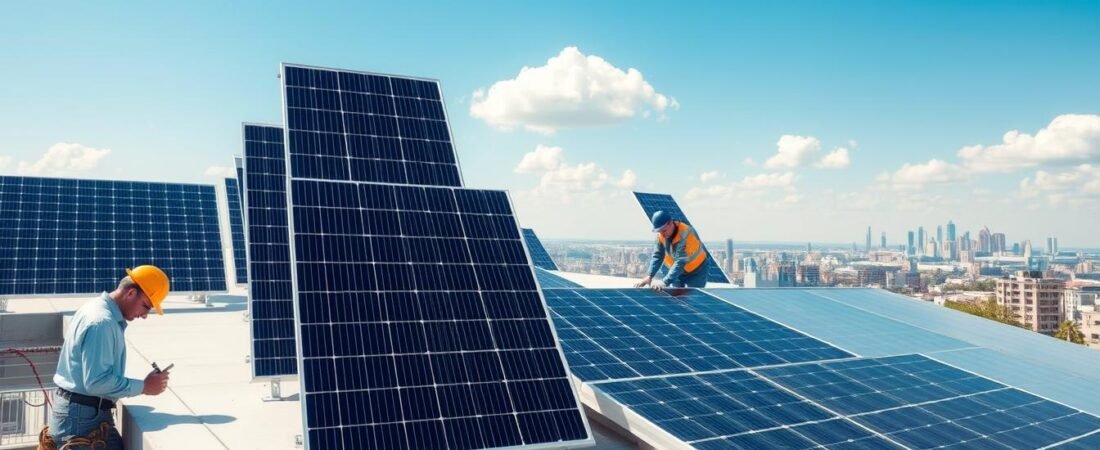
Maysun Solar has built quality photovoltaic modules since 2008, helping homeowners and businesses get more from dual‑sided systems. This guide explains how these modules capture light on both sides to boost energy production and improve overall performance.
Understanding reflectivity, tilt angle, and surface type is key. Proper planning for shading and roof orientation keeps output steady through the year. Whether you work on a rooftop or a ground project, choosing the right units affects durability and long‑term efficiency.
We cover design, materials, and electrical needs so you can make smart choices. Expect clear tips on capturing more light, optimizing rear exposure, and assessing cost versus production for peak power in varied environments.
Understanding Bifacial Solar Technology
Dual‑sided module technology captures light on both faces to raise yearly energy output. This change in design affects materials, mounting, and expected performance.
Types of Modules
There are three common types: glass/glass, glass/transparent backsheet, and glass/backsheet. Each type offers distinct durability and cost trade‑offs.
- Glass/Glass: Superior strength and long life for harsh environments.
- Glass/Transparent backsheet: Lighter and more budget friendly while allowing rear light entry.
- Glass/Backsheet: A practical option where rear capture is less critical.
Design and Construction
Manufacturers use lightweight frames and reinforced glass to keep modules easy to handle and tough outdoors.
Transparent backsheets let reflected light reach the rear cells, improving performance in high‑albedo areas like snow or light gravel.
“Choosing the right construction affects durability and long‑term energy production.”
| Type | Durability | Cost | Rear Light Access |
|---|---|---|---|
| Glass/Glass | High | Higher | Excellent |
| Glass/Transparent Backsheet | Moderate | Moderate | Good |
| Glass/Backsheet | Moderate | Lower | Limited |
Tip: Match the module design to your rooftop or ground conditions and select mounting hardware that supports glass‑on‑glass builds for long service life.
How Bifacial Solar Panels Generate Extra Power
Dual‑faced modules collect direct sunlight on the front and reflected light on the back. This two‑sided capture raises total energy output compared with single‑face designs.
The rear surface is built to absorb light reflected from the ground, roofs, or nearby surfaces. In bright, reflective environments such as snow or light gravel, this adds noticeable production.
Field studies show a typical gain of 10–30% extra energy under ideal conditions. Proper height and mounting let the rear cells see more light and convert more photons into power.
Good system design reduces shading and positions modules to maximize rear exposure. That keeps performance steady across the day and season.
- Both faces capture light to increase total yield.
- Rear absorption relies on ground reflectivity and clearance.
- Mounting height and spacing control rear contribution and minimize shading.
“Dual‑sided absorption is a practical way to boost production without expanding roof area.”
| Factor | Effect on Output | Why It Matters |
|---|---|---|
| Ground reflectivity | High gain in bright surfaces | More reflected light reaches rear cells |
| Mounting height | Increased rear capture | Reduces self‑shading and improves conversion |
| Shading | Reduces both faces’ yield | Careful layout preserves daily performance |
Key Factors Influencing Energy Production
Cloud cover and the reflectivity of nearby surfaces can change yearly yield by double digits. Weather, ground reflectivity, and layout all shape how much extra power you see from two‑sided modules.
Impact of Weather and Diffuse Light
Diffuse light on overcast days scatters evenly and can boost rear capture. Studies show typical gains of about 10% on sunny days and up to 20–28% on cloudy days.
High‑albedo surfaces like snow or white gravel send more reflected light to the rear cells. That raises energy production and improves overall performance.
- Assess local weather patterns before system design to balance direct and diffuse light.
- Maintain proper height and spacing so the rear receives consistent reflected light.
- Regular cleaning preserves reflectivity and keeps power stable across seasons.
“Design choices that match ground surfaces and climate deliver the biggest year‑round gains.”
Bifacial Solar Panel Installation Best Practices
Careful mounting and spacing are the easiest ways to boost long‑term system performance. Elevate modules at least 1 meter (3.3 ft) above the ground or roof to let the rear surface capture reflected light and increase energy output.
Keep the rear clear of shadows. Choose mounts that do not cast shade on the back side. Allow airflow and avoid obstructive wiring or brackets.
Consider the extra cost of specialized hardware that improves light penetration and durability. Light‑colored rails and reflective surfaces nearby raise production with small added expense.
- Maintain row spacing to prevent mutual shading and steady daily yield.
- Use clear cable ties and neat routing so the rear stays unobstructed.
- Tailor the setup to site conditions for reliable long‑term efficiency.
“Small layout and hardware choices yield better performance and a faster return on investment.”
| Best Practice | Why it Matters | Quick Tip |
|---|---|---|
| 1 m Elevation | Maximizes rear light capture | Use taller racking or standoffs |
| Non‑shading mounts | Preserves both sides’ output | Check for shadowing at low sun angles |
| Reflective rails | Boosts reflected light | Choose light paint or aluminum |
Optimizing Mounting Height and Row Spacing
Setting the right clearance and gap between rows lets the back side harvest more light.
Ground Clearance Requirements
Industry guidance recommends at least 0.5 meters (20 inches) of clearance above ground for bifacial systems. This baseline lets reflected light reach the rear cells and reduces shading from low angles.
For commercial ground mounts, aim for 1.0–1.5 meters when budget and structure permit. Higher clearance improves airflow and cooling, which helps panel performance and long‑term power output.
Managing Row Density
Proper row spacing prevents adjacent rows from blocking reflected light. Use a ground coverage ratio that balances the number of units with available area.
Design layout to limit shading during morning and late afternoon. This preserves energy production across the day and keeps rear irradiance steady.
| Parameter | Recommended Range | Why It Matters |
|---|---|---|
| Minimum clearance | 0.5 m (20 in) | Ensures rear-side access to reflected light |
| Commercial clearance | 1.0–1.5 m | Improves cooling and maximizes gain |
| Row spacing | Site-dependent; limit mutual shade | Protects daily yield and rear irradiance |
Tip: Work with an experienced installer to set height and spacing that match ground surfaces and local conditions. Small layout changes often give the best boost in efficiency and annual energy production.
The Role of Albedo in System Efficiency
Surface reflectivity determines how much extra energy the rear side can harvest. Albedo measures how much sunlight a surface bounces back. That reflected light is the lifeline for rear‑side gains on bifacial solar panels.
High‑albedo surfaces like fresh snow (80–85%) can boost production by 30% or more. In contrast, dark asphalt reflects only 10–15% and limits any additional power.
Choose sites with light roofs, white concrete, or reflective ground covers to raise performance. You can also add white gravel or reflective mats to increase albedo where natural surfaces are dark.
“Understanding site albedo is essential for predicting yearly energy and optimizing system design.”
- Albedo is the single most important factor for rear‑side capture of reflected light.
- Surface selection influences overall efficiency and long‑term production.
- Simple ground treatments can meaningfully raise yearly power without major cost.
| Surface | Typical Albedo | Expected Effect on Rear Gain | Recommendation |
|---|---|---|---|
| Fresh snow | 80–85% | Very high; +30% or more | Ideal where seasonal snow exists |
| Light concrete / white membrane | 50–70% | High; noticeable boost | Preferred for rooftops and yards |
| Dark asphalt | 10–15% | Low; minimal gain | Avoid or add reflective cover |
Electrical Configuration and Safety Requirements
Safe electrical design starts with knowing how dual‑sided modules change current and protection needs.
Managing Increased Current Capacity
Modules with rear‑side contribution can raise short‑circuit current (Isc) by 10–30% depending on ground and light conditions.
That extra amperage means inverters, breakers, fuses, and combiner boxes must be sized to handle higher current. Undersized conductors create fire risk and lower long‑term performance.
- Confirm inverter and OCPD ratings match expected peak Isc.
- Use conductor gauges sized for the higher current plus safety margin.
- Keep cable runs neat so routing does not cast shadows on the back side and reduces maintenance risk.
| Component | Recommended Check | Why |
|---|---|---|
| Inverter | Use manufacturer sizing tool | Handles increased power safely |
| Overcurrent device | Rated ≥ expected Isc | Prevents overloads |
| Conductors | Proper gauge & insulation | Limits heat and losses |
“Regular inspections and code compliance keep systems safe and efficient.”
Work with qualified professionals who understand the voltage and current behavior of these systems. Routine checks of connections and protection devices protect energy output and reduce cost risks over time.
Comparing Bifacial and Monofacial Performance
A direct performance comparison reveals how ground reflectivity and height affect yields. The main practical difference is that two‑sided modules capture light from both faces, while monofacial panels only use the front side.
Energy gains vary by conditions. In bright, reflective sites, two‑sided units can produce roughly 5–30% more energy than standard monofacial panels. In low‑albedo settings, the margin narrows and may not justify higher cost.
Durability often favors dual‑glass construction, which resists moisture and lasts longer than typical single‑glass designs. That can improve lifetime performance and reduce replacement needs.
Cost is the trade‑off. Higher upfront price can lead to a better long‑term return if your site boosts rear contribution. Many owners find the extra production offsets the initial expense compared with expanding a monofacial array.
“Professional modeling will show whether extra production justifies the cost for your specific site.”
- Two‑sided modules: higher potential output in high‑albedo environments.
- Monofacial panels: lower upfront cost and proven performance in many installations.
- Decision drivers: ground reflectivity, clearance, budget, and energy goals.
| Factor | Two‑sided | Monofacial |
|---|---|---|
| Typical production gain | +5–30% | Baseline |
| Durability | High (glass‑on‑glass) | Moderate |
| Upfront cost | Higher | Lower |
For a detailed side‑by‑side analysis, run site modeling or check a trusted comparison guide like bifacial vs monofacial comparison. That will clarify expected energy production and payback for your project.
Financial Considerations and Return on Investment
Smart buyers compare lifetime output, not just the sticker price per watt.
Upfront cost: Two‑sided modules typically cost about $0.50 to $0.70 per watt — roughly 10% more than standard units. That small premium can be offset by higher yearly production under favorable ground and light conditions.
Payback and incentives: Increased energy yield often shortens payback. Federal tax credits, state rebates, and utility programs can lower net cost and improve returns for a bifacial solar panel purchase.
Durability matters. Many two‑faced designs last up to 30 years versus about 25 years for conventional panels. That extra life raises lifetime value and reduces replacement expense.
- Initial premium: ~10% higher cost per watt.
- Energy gains: higher annual production improves savings.
- Incentives: credits and rebates reduce net cost.
“Run a detailed cost‑benefit analysis that factors incentives, local sunlight, and ground reflectivity.”
| Metric | Why It Matters | Tip |
|---|---|---|
| Cost per watt | Sets upfront expense | Compare $0.50–$0.70 vs standard |
| Lifetime production | Affects long-term savings | Model with local light and surfaces |
| Incentives | Lower net investment | Check federal and state programs |
Bottom line: For many projects — especially large or high‑albedo sites — the higher initial cost yields faster payback and steadier returns. Run site-specific modeling to see if a bifacial solar system is the best financial choice for your energy goals.
Climate-Specific Deployment Strategies
Climate drives many of the design choices that affect real-world performance. Match layout, tilt, and ground treatment to your local weather to get the best yield and long life.
Cold Climate Advantages
High albedo from snow sends more reflected light to the rear side, boosting winter energy even when daylight is short.
Raise tilt slightly to shed snow and increase seasonal exposure. Durable, glass-on-glass modules handle freeze–thaw cycles well and lower long-term cost.
Managing High-Heat Environments
In hot regions, airflow is key. Mount units higher and allow cross-ventilation to cut operating temperature and keep efficiency steady.
Use light-colored ground covers or reflective surfaces to add reflected light without worsening heat. Monitor thermal effects and favor robust frames for harsh sun and wind.
| Climate | Primary Strategy | Quick Benefit |
|---|---|---|
| Cold / snowy | Higher tilt, reflective ground, durable glass | More winter energy, lower wear |
| Hot / desert | Elevated mounting, airflow, reflective covers | Lower operating temp, sustained efficiency |
| Tropical / humid | Corrosion-resistant frames, cooling space | Longer lifespan, steady output |
“Plan by climate to protect performance and control lifecycle cost.”
Future Trends in Bifacial Solar Technology
Predictive analytics and AI are starting to tune arrays in real time to capture more reflected light from the ground.
The global market is growing fast. It is expected to rise from $8.7 billion in 2021 to $31.1 billion by 2031. By 2030, these systems could hold about 35% of the PV market.
Advances in materials like TOPCon and HJT push cell efficiency higher. Manufacturing improvements will lower cost and make the technology practical for more rooftop and residential projects.
Standards such as IEC 61215 are moving toward consistent testing. That makes performance claims easier to trust. Designers will focus on durability and faster installation to cut labor and time on site.
“Continued investment will help this technology play a vital role in the global shift to reliable, local energy.”
| Trend | Benefit | Expected Timing |
|---|---|---|
| AI & Predictive Analytics | Real-time yield optimization | Now–5 years |
| New Cell Tech (TOPCon, HJT) | Higher conversion | 3–7 years |
| Lower Manufacturing Cost | Wider residential uptake | 5–10 years |
- Takeaway: Expect smarter systems that harvest more sunlight and lower long‑term cost while simplifying installation.
Conclusion
Good planning and honest site assessment turn potential into steady, long‑term output.
Bifacial panels offer a clear path to higher yearly yield by capturing reflected sunlight on both faces. Proper siting, adequate clearance, and correct electrical sizing matter most for reliable performance.
Expect a slightly higher upfront cost, but count on stronger lifetime production and durability when conditions favor rear gain. Routine checks and thoughtful installation reduce risk and keep returns steady.
Use this guide to weigh costs, model expected output, and decide if these modules match your energy goals. With the right approach, capturing extra sunlight becomes a practical way to increase long‑term value.