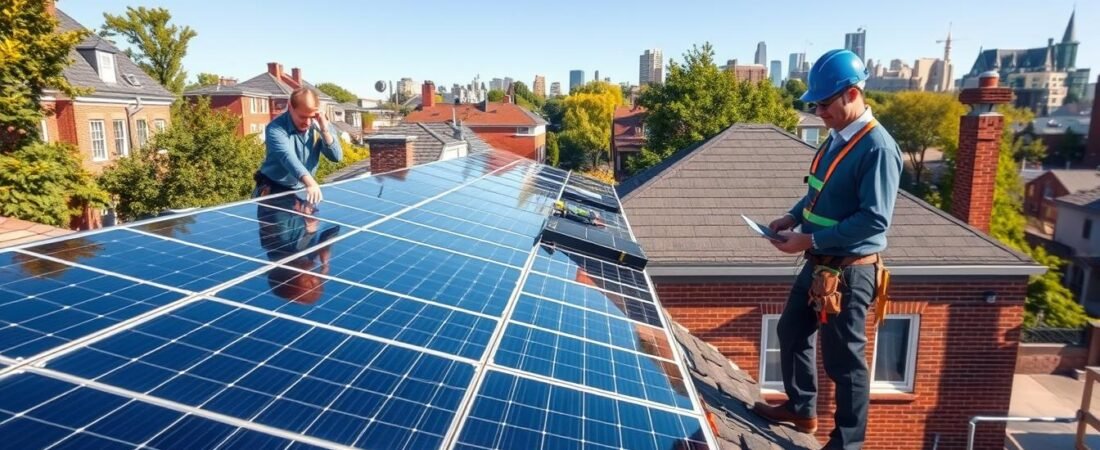
Your trusted choice for reliable Boston solar panel installation — quality workmanship, clear communication, and systems built to endure New England weather.
For homeowners and small businesses in the Greater Boston area, reliable means correct sizing, safe electrical work, tidy roof attachments, and dependable production monitoring.
Our company brings real proof: 6,000+ successful projects across New England, 13 years of experience, and 1,100+ five-star reviews. We back systems with a 30-year warranty to protect your investment.
On this page you’ll find options for solar panels, inverters, and battery backup, plus benefits, incentives, financing, and a clear installation timeline.
Ready to get started? Request a quote or schedule a free virtual consultation to review your roof fit and energy goals.
Boston solar panel installation for homes and businesses
Whether you own a house or run a facility, choosing the right system changes your energy bills.
Residential setup for local homeowners
Residential projects focus on lowering or eliminating monthly electric bills. A technician evaluates roof size, orientation, and shading to estimate output.
We compare typical household usage to find the right array size and assess roof condition before any panel installation.
Commercial solutions for offices and facilities
Businesses aim to control operating costs and meet sustainability goals. Common sites include offices, warehouses, and municipal facilities.
Our commercial work includes large local venues like Fenway Park, showing we can scale safely and meet strict timelines.
System options and backup with battery
Typical configurations include grid-tied systems and solar + battery for backup power. Batteries keep essential loads running during outages.
- On-site installers: safe work practices, tidy conduits, and code-compliant wiring.
- Aesthetics: panel layout and route planning balance curb appeal with performance.
| Project Type | Primary Goal | Typical Timeline |
|---|---|---|
| Residential | Lower electric bills | 1–3 days |
| Commercial | Cost control & sustainability | Several days to weeks |
| Battery-backed | Backup power for essentials | Added during system design |
Choosing the right company matters as much as choosing equipment. Professional service ensures safety, reliable production, and long-term satisfaction.
Why Boston-area customers choose our solar company
Local homeowners and businesses pick our company for one reason: steady, accountable work that reduces surprises. With more than 6,000 completed projects across New England and 13 years of service, our experience shows up in smoother permitting, varied roof work, and predictable results.
Proven scale and reliability
Handling thousands of installs means we’ve seen many roof types, towns, and permit offices. That scale reduces surprises and signals consistent quality.
In-house installers who own the work
Our team of employee installers follows uniform training and safety standards. That continuity improves timelines, communication, and the customer experience from kickoff to final inspection.
Verified reviews and long-term care
With 1,100+ five-star reviews, prospects learn how we communicate, meet schedules, and fix issues quickly. Those reviews are social proof of service and follow-through.
Built for harsh winters and year-round energy
Systems are designed to handle snow, wind, and cold so panels keep producing across seasons. We also back systems with monitoring, ongoing support, and a 30-year warranty for long-term peace of mind.
Commercial capability on visible projects
Work at high-profile sites like Fenway Park shows we coordinate with busy operations and deliver professional results on larger projects.
Benefits of going solar in Massachusetts right now
Massachusetts remains one of the strongest states for adoption thanks to incentives and net metering that improve the economics for many properties.
Electricity bill savings and protection from rising utility costs
Going solar can cut or eliminate monthly electricity bills. By offsetting grid usage, a properly sized system reduces what you buy from the utility and cushions you from future rate hikes.
These savings add up over time and are a central part of the financial benefits of switching solar for many homeowners.
Energy independence from an increasingly unstable power grid
Producing your own energy lowers reliance on the grid and increases resilience. Pairing a battery gives backup power during outages so essential circuits stay on.
Lower carbon emissions with clean solar energy
Solar energy is a clean source that helps homes and businesses shrink their carbon footprint. Choosing renewables is a practical step toward a greener home and community.
Home value upside for homeowners who install solar panels
Lower operating costs and a modern energy upgrade make a property more attractive to buyers. Many owners report stronger curb appeal and higher satisfaction after switching solar.
“Reduced bills, more resilience, and a smaller carbon footprint make the benefits clear.”
Decision checkpoint: If your electricity bills are high, your roof is in good shape, and you plan to stay long term, solar is often a strong fit.
Benefits are real, but incentives, financing, and system details determine final payback—see the next section on incentives, financing, and cost drivers.
Solar incentives, financing, and cost considerations
Incentives and financing often turn curiosity into action by making costs clearer and more manageable. This section answers common questions about affordability and what to gather before a quote.
Federal tax credit
The federal 30% tax credit applies to qualifying solar panels and battery storage. It reduces eligible project costs and can be claimed on your tax return.
State incentives and net metering
Massachusetts offers extra incentives and net metering that credit production against utility bills. These programs boost savings over the life of a system.
Financing options
Common paths include cash purchase, a solar loan, or third‑party arrangements. If your need is a short payback, loans can speed returns. If you prefer low upfront costs, financing spreads payments.
What drives costs
- System size and expected energy use
- Roof condition and any required repairs
- Electrical upgrades or permitting needs
| Item | Impact | Typical note |
|---|---|---|
| System size | High | More kW = higher upfront, larger long‑term savings |
| Roof work | Medium | Older roofs may need repair before work |
| Battery | Medium | Adds backup but raises initial costs |
Decision tips: Bring two recent electric bills to a consultation. Ask for an itemized quote, incentives applied, and expected payback. Plan early—paperwork and incentive windows can affect timing.
Our solar installation process and timeline
From the first Zoom call to powering your home, we guide each step with transparency and care.
No-obligation virtual consultation
What to expect: a 60–90 minute Zoom meeting that reviews roof fit, how many panels will fit, projected production, costs, incentives, savings, and financing.
Bring two recent electric bills and any questions you have so we can give personalized information and a clear preliminary timeline.
Custom system design
Our designers create a system that balances performance and clean aesthetics. We place equipment so the array meets energy goals and looks neat on the roof.
Permitting handled by our team
Customer Experience Coordinators prepare and submit permits and required documents. They keep the customer updated as approvals progress.
Installation time expectations
Many projects finish in as little as one to three days. Typical work includes racking, wiring, setting panels, and hooking up the inverter.
Inspection, commissioning, and utility permission
After local building inspections and our quality checks, we submit for utility permission to operate. The system stays off until interconnection is approved.
Production monitoring and next steps
Once live, you’ll get access to production monitoring to track power and trends. If output looks off, contact our support team and we’ll investigate.
- Schedule virtual consult (60–90 min Zoom).
- Receive custom design and itemized quote.
- Permits submitted by our customer experience team.
- Install in 1–3 days (typical).
- Town inspection → utility permission to operate → system turned on.
Ready for specific timing at your address? Request a consultation with our team to get tailored information and a precise timeline.
Conclusion
When you choose an experienced team, the path from quote to operation is clear and reliable. Our company pairs proven experience with straightforward communication to deliver real results for homeowners and businesses in the Greater Boston area.
Customer outcomes matter: expect lower energy bills, more predictable monthly costs, and the option for backup power when a battery is added. Incentives and financing often improve payback and we explain options plainly.
Quick checklist: confirm roof condition, review recent electric use, compare proposals, and ask about warranties, monitoring, and support. With 6,000+ installs, 1,100+ five-star reviews, and a 30-year system warranty, our company stands apart from other solar companies.
Ready to move forward? Request a quote or schedule a free virtual consultation to get a custom design, estimated savings, and a clear project timeline.