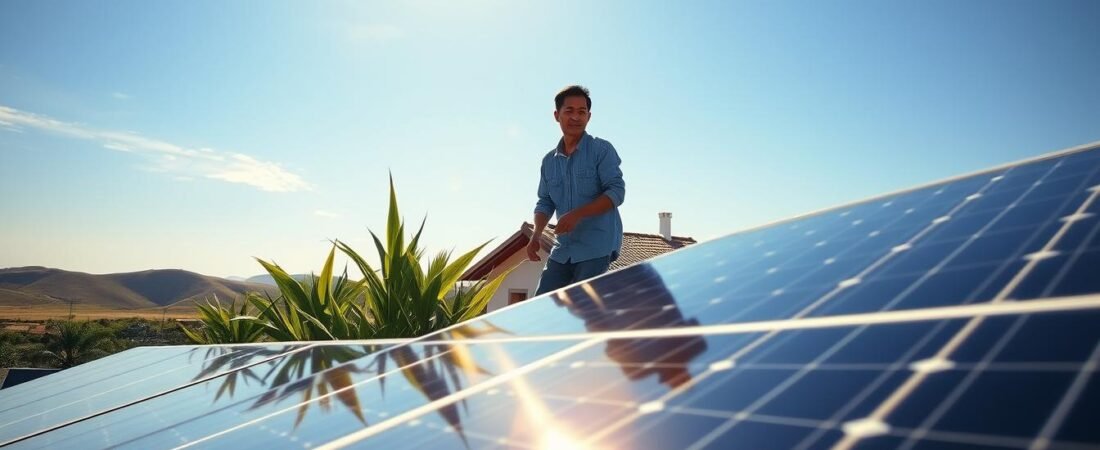
Ready to compare options and get accurate quotes? This buyer’s guide helps homeowners and business decision-makers weigh choices, estimate costs, and pick a reliable installer for long-term performance.
We cover system types, how to read kWp numbers, what a site survey looks like, and the factors that usually change pricing. Expect clear comparisons of solar panels and full systems so you can request proposals with confidence.
The Philippines averages about five hours of sunshine per day, making solar energy an accessible renewable choice. You’ll learn how converting sunlight into usable power can cut grid dependence and lower bills.
Key decision drivers include projected electricity savings, durability in tropical weather, and getting accurate quotes for solar panel installation philippines. Panel choices and site conditions often change outcomes, so this guide helps you ask better questions before you sign a contract.
Who this is for: Homeowners and commercial buyers evaluating proposals.
What you’ll gain: Clear comparisons, cost clarity, and the right questions to ask installers.
Why Going Solar Makes Sense in the Philippines Right Now
Strong daytime irradiance across much of the country turns rooftop systems into reliable sources of usable power. That steady sunlight matters because real output rises when panels get consistent, direct light.
Abundant sunshine and strong solar energy potential
More sun hours mean more hours generating clean energy. In practice, this raises the number of kilowatt-hours a system can deliver each day.
How panels cut your electricity bill and support cleaner power
Daytime generation offsets the most expensive part of typical bills by serving appliances when they run most.
- Less reliance on fossil-fuel generation lowers emissions and improves local air quality.
- Exporting excess under net metering can create additional savings later on.
- Owning a system acts as a long-term hedge as grid rates change.
“Match system size to how you use energy during the day to get the best results.”
Tip: The guide will help you size systems to actual use patterns so you see real cost and performance benefits.
solar panel installation philippines: What Buyers Should Know Before Getting Quotes
Understanding common choices and sizing terms makes comparing proposals easy. Read this short guide before you contact installers so quotes are apples-to-apples.
Grid-tied vs. other system setups
Grid-tied is the most common type offered in quotes. It uses daytime generation first, then draws from the grid as needed. That keeps costs lower and simplifies permitting.
Off-grid or hybrid setups add batteries and extra equipment. Those types raise upfront cost and change maintenance needs.
What “kWp” means and how it affects cost
kWp is a sizing term that estimates peak output under ideal sun. Common examples are 1.6, 3.2, and 5.6 kWp systems.
Higher kWp usually means more modules, inverters, and labor, which raises panel installation cost and overall pricing.
What a site survey checks on your property
- Dedicated roof space and tilt/shape
- Structural capacity and roof material suitability
- Shading from trees or nearby buildings
Note: Survey findings can change the final quote when mounting methods or extra wiring are needed.
Quote readiness checklist: last three bills, roof photos, and notes on major daytime appliance use.
Solar Panel Installation Cost in the Philippines in 2024
Cost ranges give you a practical benchmark to judge whether a proposal is fair and complete.
Typical price ranges per kilowatt
Residential systems commonly run about Php 30,000–50,000 per kW. Commercial systems often fall lower, near Php 20,000–30,000 per kW. Residential per-kW price is higher because small jobs carry proportionally higher labor and logistics costs.
Sample installed prices (grid-tied)
- 1.6 kWp: Php 108,000
- 3.2 kWp: Php 183,000
- 5.6 kWp: Php 270,000
What an installed quote usually includes
- Modules, inverter, mounting, wiring, protection, and labor.
- Optional upgrades (batteries, microinverters, structural reinforcement) are often extra.
Prices shift over time. Manufacturing gains, stronger competition, and lower labor costs have pushed solar panel costs down. That trend can lower future installation costs, but site complexity and equipment choices still drive final totals.
“If a quote looks far below market, verify specs, warranties, and exclusions before you sign.”
Choosing the Right System Size for Your Home or Business
Start sizing your system by looking at a typical month of electric bills and noting daytime use patterns. Read the kWh totals and mark which appliances run during peak daylight hours.
Why daytime use matters: production peaks when the sun is up. Appliances that run then — refrigerators, air-conditioning, pumps — give the most immediate savings.
Map bills to realistic size examples
Use these guideposts to picture how a system may offset bills:
| Monthly Bill (PHP) | Typical kWp Size | Common daytime appliances |
|---|---|---|
| ~12,000 | 1.6 kWp | 1–2 refrigerators, daytime AC |
| ~15,000 | 3.2 kWp | Multiple fridges, AC, pool pump |
| ~20,000 | 5.6 kWp | Heavy daytime use: washers, vacuums, multiple AC |
For businesses, align size with operating hours and steady equipment loads to maximize self-consumption. List major appliances and estimated run times before you request a final, site-specific proposal.
Practical limits: roof space, shading, and budget all cap size. The best system fits your site and gives the fastest payback.
Want a quick sizing guide? See how to determine the right size and learn more about installers at our team.
Roof and Site Factors That Can Raise or Lower Installation Cost
Not all roofs are equal — their material, tilt, and nearby shade drive both performance and price.
Roof material, type, and condition
Your roof’s condition and what it’s made of determine safety and engineering needs. Metal and concrete tile roofs usually accept mounts easily. Wood or brittle shingles can be unsuitable and may need replacement first.
If the structure cannot carry extra weight, an engineer may recommend reinforcement. That raises labor and materials on the quote.
Sunlight exposure, shading, and tilt
Direct sunlight and minimal shade maximize production. Trees or tall buildings that cast shade can lower output and force a different layout.
Tilt and orientation affect how many panels you need to hit the same energy offset. A shallow tilt or west-facing roofs often require more modules for the same return.
Structural capacity and dedicated roof space
Installers look for clear, uninterrupted roof areas with room for maintenance. Small or oddly shaped sections complicate mounting and increase labor time.
Key quoting drivers: roof access, required reinforcement, and layout constraints can raise costs even when equipment choices stay the same.
| Factor | Common impact | How it affects quotes |
|---|---|---|
| Material (metal, tile, wood) | Mounting ease varies | Extra flashing or roof work raises labor and parts |
| Shade and sunlight | Production loss or panel relocation | May need more modules or different layout |
| Tilt and orientation | Performance per module changes | More modules increase cost to meet targets |
| Structural capacity | Need for reinforcement | Engineering and materials add to total |
Equipment That Impacts Price and Performance
Equipment choices shape both upfront cost and the real output you’ll see on your meter.
Material types and how they trade cost for space
Monocrystalline modules offer the highest efficiency but come at a premium. They work well when roof space is limited.
Polycrystalline gives a middle ground: lower cost with decent efficiency. It suits larger roofs where space is available.
Thin-film is cheapest and flexible, but it needs more area to hit the same output.
Why the inverter matters for usable electricity
The inverter converts DC into usable AC electricity for your home. A higher-quality inverter loses less energy and handles shading or variable output better.
Choose an inverter with a clear warranty and good efficiency specs to protect long-term yield.
Mounting choices and roof compatibility
Mounting systems must match your roof type—metal, tile, or shingle—to avoid leaks and extra labor.
Ask about wind-load ratings and attachment details. In this region, mounts should resist high winds, heavy rain, and heat to last.
Durability for local weather
Durability matters: corrosion resistance, high-temperature performance, and proven wind ratings reduce repair costs over time.
“Buy components rated for extreme conditions, not just the lowest sticker price.”
- Quick quote checklist: panel warranties, inverter warranty length, mounting design details, wind-load rating and installation standards.
- Focus on lifetime output and service support, not only upfront cost.
Getting the Installation Right: How to Pick a Reliable Installer
A well-done job today protects your energy output and avoids costly repairs later. Choosing who will do the work affects long-term performance and the money you save each year.
What to check in workmanship, warranties, and support
Installer quality matters as much as equipment. Great components can underperform if mounts are loose, wiring is sloppy, or the system is configured wrong.
Buyer vetting checklist:
- Valid licensing and a solid track record with similar roofs and sizes.
- A clear scope of work and documented commissioning steps.
- Transparent service terms, response times, and escalation paths for repairs.
Warranties you should get in writing: product coverage, a multi-decade power guarantee, and labor or service commitments that protect your money over time.
“Solaric, for example, cites a 25-year lifespan, a 10-year product warranty, and a 25-year power output guarantee, plus an in-house crew of 50+ and after-sales support.”
Ask who will perform the work — in-house crew or subcontractors — and request references or a portfolio before you decide to install solar panels.
Permits, Net Metering, and Incentives That Affect Your Total Costs
Before you sign a contract, check what permits and grid rules will add to your timeline and costs.
Do you need a permit?
Yes. Permits are usually required and the exact paperwork depends on your city or municipality and whether the property is new or existing.
Common documents and timelines
Typical documents include an electrical permit application and five sets of electrical plans and specifications.
Some areas also ask for a roof building permit, Barangay Clearance, or Barangay Permit.
Processing time varies by location. Manila can clear permits in about one business day. Other cities often take 1–5 business days.
Net-metering basics
Net-metering means excess power you produce goes to the grid and earns credits. Those credits lower your electricity bill later.
To save money, align generation with daytime use so you export only true excess. That makes savings more predictable.
Government incentives for businesses and buyers
The national government offers incentives that can reduce the effective cost solar ownership for businesses.
- Possible 7-year income tax holiday and tax reductions.
- Zero VAT on eligible equipment and duty exemptions on imported spare parts.
When you compare prices, confirm whether permitting support and interconnection or net-metering help are included in the quoted costs.
“Ask your installer if they handle permits and utility interconnection — it often saves time and avoids hidden costs.”
Conclusion
A clear purchase rule: match system size to daytime demand, your roof limits, and your budget.
Do this and you capture the biggest benefits: lower bills, cleaner energy, and long-term reliability. Actual results depend on shading, sunlight exposure, and correct sizing.
Remember the main cost drivers: equipment tier, roof and mounting complexity, permits, and installer workmanship. Compare itemized quotes and check warranties and service support alongside price.
Next step: gather three months of bills, note major daytime loads, and request at least three detailed quotes so you can compare installation costs fairly.
Decide wisely: pick a reputable installer, confirm permits and net-metering help, and prioritize durability so your solar investment performs for decades.