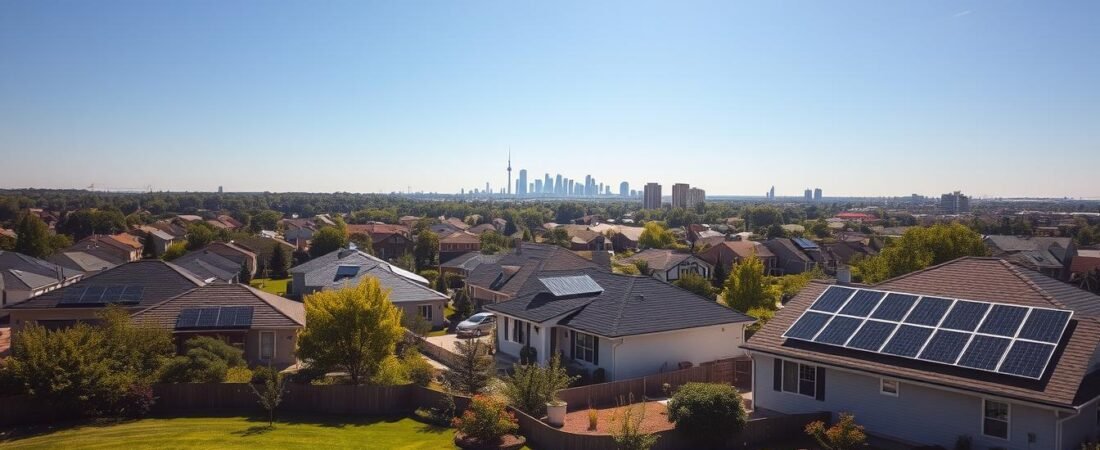
This buyer’s guide helps Grand Rapids homeowners understand today’s installed pricing and what drives those numbers. You’ll learn how to compare quotes, estimate savings under local utility rules, and pick the best options for your home.
Prices aren’t a single figure. Final totals vary by system size, roof condition, equipment tier, and the installer’s approach to labor and permits in Grand Rapids. We’ll show typical benchmarks, like a ~6.2 kW system, and sample pricing examples specific to the area.
Expect clear steps on sizing from your electric use, how production shifts through West Michigan seasons, and how net billing affects exported power value. We also cover incentives and financing options such as Michigan Saves loans and PACE, plus how policy changes may affect tax credit assumptions.
By the end, you’ll know what to ask a company, how to spot offers that seem too good to be true, and which choices match your budget and goals—whether you want the lowest price per watt, a strong warranty, or the simplest installation experience.
Why Grand Rapids homeowners are looking at solar right now
Rising utility prices are changing how people think about home energy. In Michigan, residential electricity rates have climbed about 19% since 2020 to roughly 19.29¢/kWh. That sits above the U.S. average near 16¢/kWh.
What that means for homeowners: every kWh you generate replaces higher-cost grid power. Consumers Energy averages about 18.80¢/kWh and Great Lakes Energy about 17.70¢/kWh, so local production has extra value compared with many parts of the country.
How rising rates show up in monthly bills
Higher rates push up monthly energy bills even when usage is steady. A 19% rise since 2020 compounds each year into noticeably larger bills for families.
What “worth it” can look like over 25 years
Look past simple payback. Homeowners often use a 25-year window because warranties and performance estimates use that span.
- Think of on-site generation as rate insurance against future spikes.
- Total 25-year savings can be large—local estimates show typical homes saving ~ $40,000 over that period.
- The best investment matches your usage, roof layout, and whether you prefer ownership or monthly payments.
| Metric | Value | Why it matters |
|---|---|---|
| MI avg rate | ~18.80¢/kWh | Higher baseline raises value of produced kWh |
| US avg rate | ~16.0¢/kWh | Shows local premium vs. national price |
| 25-year example saving | ~$40,000 | Frames long-term financial benefit |
Next step: understanding local pricing benchmarks is the starting point for fairly comparing installer quotes.
solar panel cost grand rapids: average prices, real ranges, and what to expect
A clear pricing snapshot helps you compare quotes fairly. Use the commonly cited ~6.2 kW system as a relatable reference. Many homes will need a smaller or larger system depending on use and offset goals.
Typical installed cost for a 6.2 kW system: EcoWatch lists about $25,098 before the federal tax credit and roughly $17,551 after that credit in their example. Palmetto shows a recent quote near $20,340 at about $3.19/W.
Price per watt and regional benchmarks
Michigan data often centers near $3.05/W statewide, but local quotes can range above or below that. Treat $/W as a starting benchmark—not a final guarantee.
Before incentives vs. after incentives
Before incentives is the full installed price. After incentives subtracts federal and local rebates, which can shrink your net number substantially. Compare quotes with the same assumptions to avoid apples-to-oranges results.
| Reference | System size | Reported price | $/W |
|---|---|---|---|
| EcoWatch example | 6.2 kW | $25,098 before / $17,551 after | ~$4.05/W |
| Palmetto quote | 6.4 kW (example) | $20,340 | $3.19/W |
| MI benchmark | 11.52 kW | $35,103 before | $3.05/W |
All-in quotes in this area commonly span roughly $20k–$40k. Factors that push a price up include higher-tier equipment, difficult roof work, and add-ons like storage. Get multiple quotes using the same system size, equipment tier, and financing assumptions.
Next up: the biggest cost drivers—equipment tier, roof constraints, labor, permitting, and batteries—so you can see what really moves a quote toward the low or high end.
What drives the cost of solar panels and installation in Grand Rapids
Many factors change what you’ll pay for a rooftop system in West Michigan. The single biggest driver is system size: higher household electricity use needs a larger system, more modules, and extra labor hours. EcoWatch notes local spend per kW near $4,060 in this area as a helpful benchmark.
System size and your electricity use
Your monthly kWh sets the required system size. Bigger systems raise the total price but often lower price per watt. Right-sizing helps avoid overspending while meeting your offset goals.
Panel efficiency, inverter type, and equipment tier
Higher-efficiency panels and premium inverters cost more up front. They can save roof space and improve long-term performance. Choose brands with solid warranties to reduce future risks.
Roof condition, shading, and layout constraints
Older roofs, steep slopes, lots of shade, or many roof sections increase labor time. That raises installation fees and may require custom flashing or racking to fit odd shapes.
Labor, permitting, and interconnection
Soft costs — permits, inspections, utility interconnection, and installer overhead — vary widely by company. Ask for a line-item quote so you see these fees clearly.
Add-ons that change the price
Common upgrades include battery storage for backup, EV charger integration, and advanced monitoring. Batteries add notable dollars but boost self-consumption and resilience.
- Tradeoff tip: Paying more for quality equipment and workmanship can lower repairs later.
- Lowest bids sometimes omit service or use lower-quality components.
- Best cost control: match system size and equipment to your roof and energy profile.
| Factor | How it affects price | What to ask |
|---|---|---|
| System size (kW) | Directly proportional — more kW = higher total spend | What size meets my average monthly kWh? |
| Equipment tier | Premium brands raise upfront price but may last longer | Which brands and warranties are included? |
| Roof & layout | Complex roofs increase labor and material needs | Will roof repairs be needed first? |
| Soft costs | Permits, inspections, interconnection add to the quote | Show permit and utility fees as separate items |
| Add-ons (battery, EV) | Can add significant value and expense | What payback or backup benefits does a battery provide? |
Choosing the right solar system size for your home
Start with a clear annual picture. Collect the last 12 months of electricity bills for your home and add the kWh totals. That annual number is the fastest way to get a realistic system size estimate for grand rapids.
Estimating size from your bills
Divide your 12‑month kWh total by a local production factor. In Michigan, ~1,100 kWh per kW per year is a common planning assumption.
- Example: 11,000 kWh ÷ 1,100 = ~10 kW system.
- Use this as a baseline to compare installer quotes and expected output.
Seasonal production expectations
Expect strong summer power and lower winter output. A system sized to meet July needs may still draw from the grid in December.
Choosing an offset goal
Partial offset can lower bills with a smaller system. Near‑100% offset fits homes with large roofs, room in the budget, or plans for an EV or heat pump.
Net billing rewards self‑consumption, so size decisions should reflect when your home uses energy during the day.
For local benchmarks and detailed pricing context, see local pricing data. Next, we’ll convert system size into expected annual kWh and dollar savings.
How much energy solar panels can produce in Grand Rapids
Local sunlight patterns determine how much electricity a rooftop system will actually deliver each month.
Peak sun hours are an easy way to think about that. One peak sun hour equals the energy from one hour of full midday sun. In the Grand Rapids area the value used for planning is about 4.3 peak sun hours per day, which explains the strong summer production you’ll see.
Reading PVWatts-style expectations
PVWatts-style estimates start with your system size in kW, adjust for local sun hours, and subtract typical losses (inverter, soiling, shading). That gives a projected annual kWh total you can use for budgeting.
Example: a 10 kW system
Using ~4.3 peak sun hours, a 10 kW system roughly yields 10 kW × 4.3 hours × 365 days ≈ 15,695 kWh/year before losses. After typical losses you might expect ~13,000–14,500 kWh per year.
Translating kWh into dollars saved
To turn production into savings, multiply produced kWh by your retail electricity rate for the portion you use on-site. Self-consumed energy avoids the full retail charge and is most valuable under net-billing rules.
Example: 13,500 kWh × $0.31/kWh ≈ $4,185/year in avoided bills if most production is self-used. Monthly results vary: summer months often cut bills substantially, while winter output is lower and you may draw more from the grid.
Tip: Always request a site-specific production model. Installer estimates can differ; a model that includes roof angle, shading, and local weather gives the most realistic view and helps you compare projected savings. How exported power is credited by your utility will also change the true value of any extra production.
Understanding Grand Rapids utility rules: net billing, export credits, and self-consumption
Local utility rules now treat exported energy as a credit, not a one-to-one swap with retail power.
How net billing works in practice
Under net billing your home uses on-site generation first. Extra output is sent to the grid and earns an export credit rather than full retail payback.
Export credit levels and why they vary
Typical export credits range from about 8.5¢ to 16¢/kWh. Rates shift by time of day, season, and utility calculations. Peak midday value can be higher than night rates.
Maximizing savings when credits are lower than retail
Self-consumption is the most valuable strategy. Each kWh used on-site offsets the full retail electricity price, increasing overall savings.
- Run dishwashers and laundry during sunny hours.
- Shift EV charging to mid-day when generation is highest.
- Use smart thermostats or timers to align use with production.
Rollover and planning: unused export credits usually roll over as dollar balances and apply to future supply charges. That helps with seasonal swings but does not equal full net metering value.
| Feature | Typical range | Why it matters |
|---|---|---|
| Export credit | 8.5¢–16¢/kWh | Lower than retail; varies by time and season |
| Self-consumption value | ~Full retail rate | Highest immediate savings per kWh |
| Rollover credits | Dollar-based monthly | Offsets future supply charges; helps seasonal balance |
Ask installers to model payback using net billing assumptions, not legacy net metering. Even with reduced export credit values, incentives and financing can improve project math for homeowners considering a new system.
Incentives and rebates that can reduce your solar costs in Michigan
Michigan offers several grants and financing tools that can shrink your upfront bill or spread payments over years.
How incentives work: some rebates cut the upfront money you pay, while tax credits reduce your federal or state tax liability. Other programs improve financing terms so monthly payments are smaller. Whether you own the system or use a lease/PPA changes which benefits apply.
Property tax treatment for owned systems
Many homeowners ask if adding generation raises their assessed value. In Michigan, local treatment can vary.
Confirm with your assessor or company before signing so you know whether an owned system will affect property tax.
Michigan Saves loan program
Michigan Saves offers unsecured Home Energy Loans from $1,000 to $50,000. Terms go up to 15 years, and APRs range roughly 4.44%–7.90% (many around 5.50%).
Because these loans are unsecured, they differ from home‑equity borrowing. That matters when you compare rates, closing steps, and repayment risk.
PACE and commercial pathways
For commercial, multifamily, or agricultural properties, Lean & Green Michigan PACE lets owners repay via a property tax assessment with terms up to 25 years.
PACE is not available for single‑family homes, so businesses and larger owners should evaluate it as a long-term funding option.
“Ask your installer for an incentive checklist that matches your property type and financing choice.”
| Program | Who it fits | Key terms |
|---|---|---|
| Michigan Saves | Homeowners (single-family) | $1k–$50k, up to 15 yrs, APR ~4.44%–7.90%, unsecured |
| Lean & Green (PACE) | Commercial, multifamily | Repaid via property tax, up to 25 yrs, not for single-family |
| Federal incentives | Depends on ownership | Tax credit rules vary by purchase vs lease; verify current federal tax credit treatment |
Bottom line: incentives and rebates in Michigan can lower upfront money and improve investment returns. Ask your company for a tailored checklist that shows which rebates, loans, or tax credits apply to your home or property type.
Solar financing options in Grand Rapids: cash, loan, lease, and PPA
How you finance a home energy system determines upfront needs, tax benefits, and service responsibility. Below are the four common options for homeowners in the area and what each means for monthly bills and long‑term savings.
Buying with cash
When it makes sense: you want the highest lifetime savings and can afford the upfront price without stretching your budget. Cash avoids interest and keeps federal tax credit benefits directly with the owner.
Watch for: roof repairs or warranty transfers that might add time or money after installation.
Loans
Loans let you own while spreading payments. Watch APR and term: a long term lowers monthly payments but raises total interest paid.
Tip: compare the total paid over the loan, not just the monthly amount.
Leases and PPAs
These options often require no money down. The provider owns the system, handles maintenance, and you pay a set monthly fee or per‑kWh rate.
Example: Palmetto LightReach advertises no upfront investment, maintenance by the provider, a 90% production guarantee, and sample payments starting near $73/month. Major utilities such as DTE Energy and Consumers Energy commonly support PPA availability.
How provider pricing uses tax credits
Leasing companies can factor the federal tax credit into their pricing model. That means contract pricing may shift if ownership incentives change. Ask the company how they treat tax credits and whether savings are passed to the homeowner.
Buyer checklist before signing
- Escalator clauses: does the payment rise over time?
- Transferability: what happens if you sell the house?
- Maintenance and response time for repairs.
- Monitoring access and production guarantees.
- Who pays for inverter or module replacement?
| Option | Upfront | Maintenance | Ownership | Example monthly |
|---|---|---|---|---|
| Cash | High | Owner | Owner | None |
| Loan | Low–Medium | Owner | Owner | Varies by APR |
| Lease | None | Provider | Provider | Starts near $73* |
| PPA | None | Provider | Provider | Per‑kWh rate |
Projecting savings, payback time, and ROI for a Grand Rapids solar investment
Comparing three financial metrics—payback, total savings, and ROI—lets homeowners judge offers on the same terms.
Payback is the years it takes for energy savings to match your net price. Use the installer’s net number after tax credits and rebates. Benchmarks in the area often show about 12.5 years under common assumptions, though estimates vary by home.
Total savings show lifetime dollars kept. One local example gives roughly $23,000 over 25 years after incentives; other estimates for similar homes reach about $40,000 depending on system size and usage.
ROI is a percentage measure of return over a chosen period. Compare 25-year net savings and include replacement costs, maintenance, and inverter service when you calculate ROI.
Why payback and savings differ
Household use, roof orientation, and export credit rules change results. Higher local rates and more on-site use shorten payback and boost lifetime savings.
Ownership vs. lease/PPA
Owning typically yields larger long-term savings because you keep tax credits and residual value. Leases or PPAs can lower near-term bills with little or no upfront cash, but they often reduce lifetime upside.
Home value and resale
Owned systems can increase resale value. A Zillow finding cites about a 4.1% premium for homes with owned systems — roughly $10,250 on a $250,000 house. Leased systems may complicate a sale if a buyer must assume the contract.
Evaluate best value: ask for a 25-year projection that uses net-billing export credits, conservative utility escalation, and site-specific production. Compare net savings, contract flexibility, and maintenance terms before deciding.
| Metric | Example range | Why it matters |
|---|---|---|
| Payback (years) | ~10–15 | Time to recoup your net investment |
| 25-year net savings | $23,000–$40,000 | Long-term dollars kept after incentives |
| Home value uplift | ~4.1% (owned) | Can add resale value; leased units differ |
| Ownership vs lease | Higher lifetime vs. lower upfront | Choose based on budget and how long you will stay |
How to choose a solar company in Grand Rapids without overpaying
A clear comparison of quotes helps you avoid surprises and identify real value.
What to compare beyond price per watt: make sure each quote uses the same system size, lists equipment model numbers, and states shading/loss assumptions. Confirm whether permitting, interconnection, and roof work are included.
Warranty coverage that matters
Look for a panel performance warranty, a multi-year inverter warranty, and a workmanship guarantee from the installer. Ask if a production guarantee is offered and whether it includes repair or financial remedies.
Contract details that protect you
Verify who is responsible for maintenance, typical response time, and monitoring access. Ensure the contract spells out roof-penetration responsibility and procedures if output drops.
Local experience and permitting know-how
Choose a company with local permits and utility interconnection experience to cut delays. Local teams understand building inspectors and can often smooth the timeline.
- Red flags: vague specs, unrealistic production, high-pressure sales, or unclear roof/repair responsibility.
- Action step: get 2–3 bids with the same scope and ask each installer how they modeled export credit and incentives in projected savings.
“Ask for line-item quotes and model assumptions so you can compare apples to apples.”
Conclusion
Match what you install to how and when your household actually uses electricity. In Grand Rapids, higher retail rates and net‑billing credits that sit below full retail make daytime self‑consumption and correct system sizing critical.
Next steps: gather 12 months of bills, request a site‑specific production model, and get several bids that use the same assumptions. Compare net numbers, warranties, monitoring, and local permitting experience — not just upfront price.
For a deeper local pricing check, see Is solar worth it in Michigan. A clear contract and realistic projections turn panels into a dependable home upgrade, not an unknown gamble.